


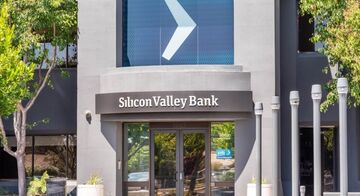
In March 2023, a run on Silicon Valley Bank caused the second-biggest banking collapse in U.S. history and endangered the tech sector’s ability to make payroll.
A particular feature of SVB was its role in the treasury strategies of many Silicon Valley companies. Those companies had millions of dollars in cash in their SVB accounts. It’s how they paid their staff. And all it took to break those companies’ payroll processes was one frantic 48-hour period, after which that cash became inaccessible to those companies.
Over that weekend, the Federal Reserve stepped in to guarantee most of the bank’s accounts and provided liquidity to those companies, but there’s no guarantee of such a safety net the next time a bank somewhere in the world fails.
Here is the point where payroll, risk management and treasury strategies come together. The SVB collapse taught the U.S. tech sector valuable lessons about banking risks and payroll continuity.
Below, we’ll make the case that payroll automation and standardization are essential components in ensuring continuity when the next bank collapses.
SVB made company payrolls especially vulnerable
SVB was different from other banks because of its position as a go-to source of financing for startups. SVB would fund businesses that other banks wouldn’t.
But that debt financing came with strings attached. “What many people don’t realize is the primary reason why so many startups had their cash balances with SVB is because it was a condition of their venture debt loans,” PartsTech CFO CJ Gustafson wrote on his Substack days after the collapse.
“In other words, for SVB to loan them [$5M] in the form of either a term loan or revolving debt facility, they had to make the bank their #1 banking partner, and move all excess cash there as collateral.”
The run on the bank began on March 8, when SVB announced it was raising capital. Customers began to speculate whether the bank had enough money to guarantee accounts, and many people tried to withdraw funds on March 8 and March 9.
The Financial Times’ Mark Vandevelde, Antoine Gara, Joshua Franklin, Colby Smith and Tabby Kinder reported in April that customers attempted to withdraw at least one-quarter of their deposits within a 24-hour period.
On March 10, California regulators stepped in to shut down SVB and place it under the FDIC, meaning accounts would be guaranteed, but only up to $250,000 — far short of what many tech companies need to make payroll.
In the U.S., failing to pay employees on time means state and federal fines. “Looking at the liquidity crisis that loomed over the weekend, employers were really between a rock and a hard place,” Kathleen Caminiti, an employment lawyer at Fisher & Phillips LLP in New Jersey and New York, told Bloomberg the week after SVB’s collapse.
“They might not have had access to their funds, but they may have still been exposed to significant damages and penalties, as well as the potential for personal liability.”
Proskauer Rose LLP attorneys Allan Bloom, Philippe A. Lebel, Katrina McCann, David Gobel and Jennifer McGrew note that employers who fail to pay wages on time are exposed to a variety of liabilities, depending on the jurisdiction, which can include:
- The unpaid wages themselves.
- Damages equal to 100 percent or even 200 percent of those wages.
- Civil penalties and attorneys’ fees.
“[W]hile an employer may have rights or claims vis-a-vis their banks or insurers, the employer is the entity with responsibility for compliance with wage and hour laws, and third-party liability won’t absolve the employer of its responsibility to make timely payroll,” Bloom et al. write.

Mitigating the risks to a global company’s finances
Companies have ways to manage these risks.
Treasury management and strategy are an obvious starting point. Toby Mather, cofounder and CEO of UK-based edtech firm Lingumi, tells The Washington Post that 85 percent of his company’s cash was in SVB when it collapsed, which “has taught us a valuable lesson about cash diversification over the long-term and monitoring our banks’ risk exposure,” he says.
But diversification is only the first step. Global companies need controls to ensure they can recognize banking risks and move cash quickly when necessary.
Case in point: Alison Staloch, CFO of real estate investment platform Fundrise, tells CFO Brew that her organization had begun fortifying treasury processes in the wake of the SVB collapse. “That includes both knowing our counterparties [and] making sure we’ve appropriately diversified our counterparty risk.”
Now, consider the entire risk horizon to global payroll. Kalei White at Trovata has a useful list, which contains:
- Currency exchange risks.
- Legal risks.
- Compliance risks.
- Fraud risks.
Global teams use a variety of process-automation tools to manage these risks. They automate currency exchange so that they buy target currencies at the most favorable prices, for example. Some invest in anti-fraud solutions or legal tech solutions to alert teams of emerging threats.
So, given the downsides, global companies should invest in tools to control and automate their global payroll processes.

How to ensure payroll continuity in the face of such risks
If a bank fails, or if a currency’s value plummets, or if a country introduces new labor laws, or if hackers compromise their data, it’s the employer that pays — dearly — for any blips in global payroll continuity.
Here are three things such companies can do to standardize and automate payroll to ensure employees get paid on time.
Map your global and country-level payroll process
This includes a map of all actions, all owners and all deadlines.
This way, whenever a problem emerges, you’ll have a way to visualize what needs to be isolated and changed.
Further, make sure your payroll team has an up-to-date list of all vetted in-country payroll providers. James Paille at IRIS Software Group Americas says to “examine the license and certifications provided by all payroll vendors and consider those that have independently audited Nacha certification.”
It’s useful to have country-specific folders, too, with as much relevant data as possible. That way, if you need to onboard a new in-country provider, you have the information readily at hand to do so quickly.
Having the right technology in place is useful here because it takes the burden off of payroll team members and puts it on the tool itself. Your payroll infrastructure becomes the main driver of your global payroll.
Move payroll to the cloud and ensure workflows can be switched as needed
On-premises storage isn’t feasible for global payroll data. This data needs to be stored in the cloud so anyone who needs access to that information can quickly get it.
The same goes for workflows. If you need to switch task owners from someone in one country to someone in another country, or if you need to quickly onboard a new in-country provider because of a local service delivery failure, the only way to achieve this is via cloud-based workflows inside a global payroll control platform.
If your technology lacks the flexibility and innovation to function as needed in a cloud environment, then it’s time to invest in new tools and purpose-built payroll technology.
Assess business continuity procedures for your team and for in-country providers
Refer to your list of vetted in-country providers, and ask them for their business continuity and disaster recovery plans. Be specific in your interrogation, if necessary. Ask a local country payroll provider what they would do if there was a run on their country’s biggest banks, or if their country’s central bank suddenly introduced a disruptive monetary policy.
Then, turn that gaze inward. Assess your company’s own continuity and disaster recovery plans. If an in-country provider is suddenly not able to deliver agreed-upon services, do you have agile payroll tech in place that allows you to pivot quickly in times of emergency?
To learn more about how the right technology can help ensure payroll continuity, have a look at how Payslip’s platform turns 15 manual tasks into six automated steps.
For more information about our Global Payroll Control Platform contact us today.