When an employee is paid incorrectly, attention naturally turns to the payroll calculation. But many payroll errors begin much earlier.
An incorrect salary update. A missing employee identifier. A bonus in the wrong format. Incomplete joiner information. An unexpected value from another payroll data source.
By the time these problems reach payroll processing, the error has already entered the process. That is why improving payroll accuracy requires organizations to think beyond calculations.
Payroll data quality starts before payroll processing begins.
Why is pre-payroll data quality so important?
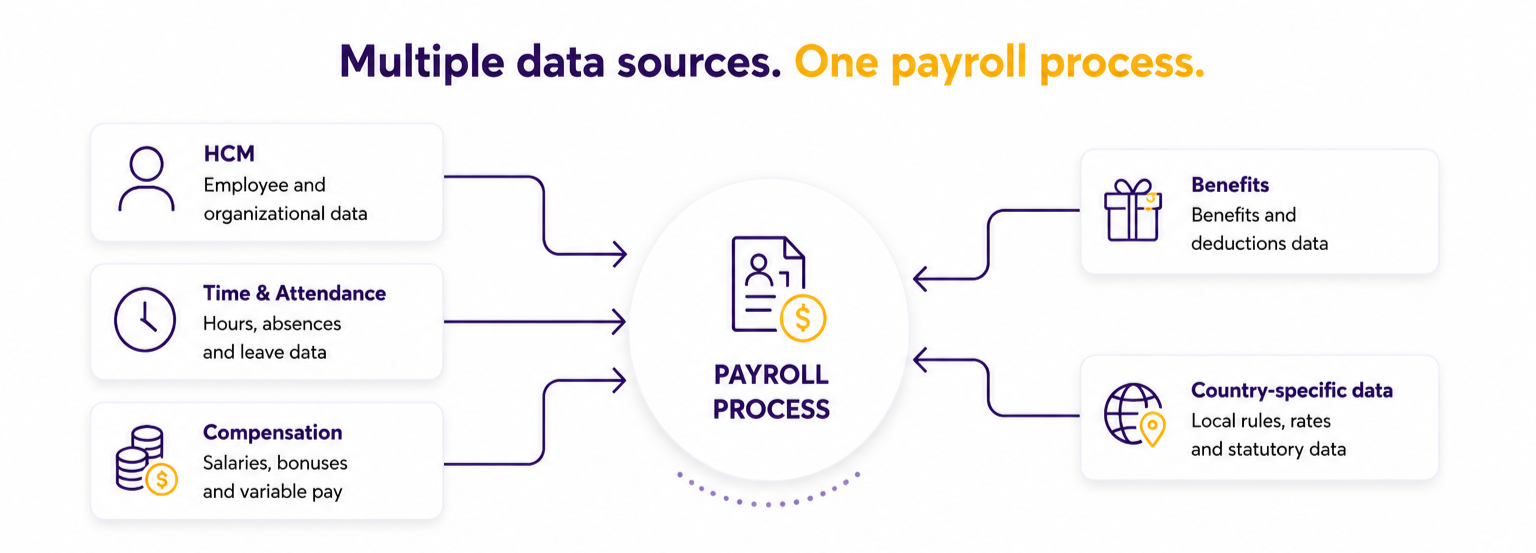
Payroll depends on information from multiple sources.
The HCM may provide employee and organizational information, but payroll can also require time and attendance, variable compensation, benefits, equity and country-specific data.
Each source creates another potential point where information can be incomplete, incorrectly formatted or inconsistent.
Multiply that across numerous countries and thousands of employees and the scale of the validation challenge becomes clear.
The traditional response is manual checking.
Payroll professionals compare files, review spreadsheets, check totals and search for missing information before sending the data for payroll calculation.
That work is necessary because the consequences of bad data are serious. But manual validation itself creates another risk: human error.
Payroll teams should find errors at the earliest possible point
There is a simple principle that can improve payroll operations:
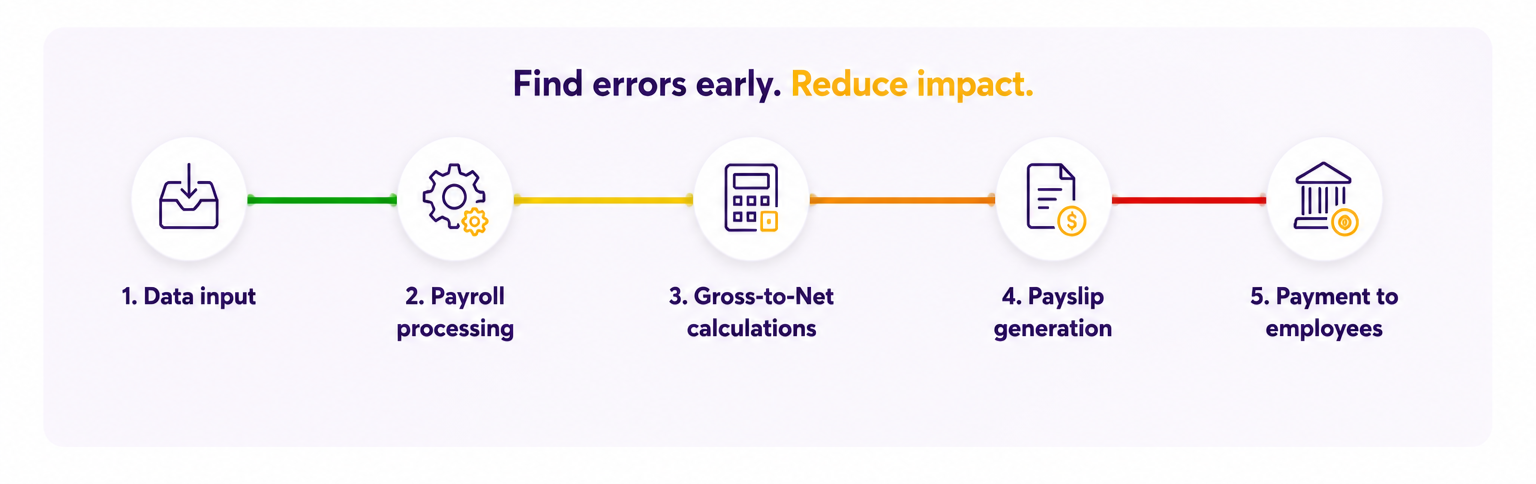
Find the error as close as possible to where it enters the payroll process.
The longer incorrect information travels through payroll, the more expensive and disruptive it can become.
An issue detected immediately after an input file arrives might require a simple correction at source. The same issue discovered after Gross-to-Net calculations have been returned could require investigation, communication with the payroll provider, a corrected file and another round of review. Detect it after employees are paid and the consequences become significantly more serious.
Early validation therefore does more than improve accuracy. It protects payroll timelines.
Automated payroll validation changes the process
Automation makes it possible to validate much larger volumes of payroll information consistently.
Payslip Control includes Automated Validations, with checks applied to data throughout the payroll process.
Pre-payroll input data can be checked to ensure mandatory fields are populated and values are in the expected format.
Validation also continues later in the cycle against Gross-to-Net calculations, employee payslips and General Ledger information.
The results are provided through validation reports so payroll teams can focus on resolving the exceptions rather than manually checking every data point.
This changes the role of the payroll professional.
Instead of spending time searching for potential problems, teams can spend more time reviewing identified issues and making informed decisions.
Validation should not be a one-time gate
Payroll data quality is sometimes treated as a checkpoint immediately before calculations begin.
In reality, data changes throughout the payroll process.
Gross-to-Net calculations arrive from payroll providers. Corrected versions may follow. Payslips are generated. Financial outputs are produced.
Every significant movement of information creates another opportunity to verify integrity. That is why validation works best as a continuous control throughout the payroll cycle rather than a single pre-payroll exercise.
Better validation can improve vendor collaboration
Automated validation can also improve the relationship between payroll teams and their in-country providers.
Local payroll providers remain essential sources of expertise for multinational organizations. When data received from a provider does not meet an agreed validation requirement, a clear validation report can help both parties identify the issue quickly. That creates a more objective and structured process for resolving discrepancies. Instead of lengthy email exchanges trying to establish what went wrong, teams can work from a clearly identified exception.
Data quality is also the foundation for payroll intelligence
There is another reason payroll data quality is becoming increasingly important.
Organizations want more from payroll data. They want consolidated reporting, variance analysis, cost insights and increasingly AI-supported analysis. Those capabilities depend on reliable information.
AI cannot compensate for fundamentally poor payroll data. Neither can a dashboard. The quality of the insight will always depend on the quality and consistency of the underlying payroll information.
So before asking what new analytics or AI capability payroll can deliver, organizations should ask a more fundamental question:
Can we trust the data entering our payroll process?
For global payroll teams, improving accuracy starts there.
Payroll Data Quality FAQs
Early validation helps find errors sooner, reducing rework and protecting payroll timelines.
Employee details, salary information, bonuses, benefits and other payroll inputs should be checked for accuracy and completeness.
Automated checks can identify data issues and exceptions, allowing payroll teams to focus on resolving them.