

Companies streamline payroll for the same reasons they streamline other core business processes: Efficiency, cost optimization and the benefits that follow from there.
In most companies, however, payroll managers don’t report to the CFO. The payroll function is outside of the purview of financial executives. And so many CFOs don’t appreciate the challenges that antiquated payroll processes are causing, nor what capabilities the organization can unlock by automating and streamlining payroll.
Let’s fix that.
Here is an overview of what streamlined global payroll can do for a global company’s efficiency, costs and competitiveness.
Cost optimization
"Best-of-class organizations prefer to handle cost reduction in a proactive, rather than reactive, manner,” Courtney Vien writes at CFO Brew. That’s the essence of cost optimization, and it’s a part of most CFOs’ missions.
Those CFOs all know that labor tends to be the biggest cost for most companies. But because global payroll sits outside of the finance team, CFOs can struggle to get the useful payroll data and analytics they need for their own cost analyses.
Digitally transforming payroll makes payroll reporting so much easier, and the data so much more accessible across teams. When your payroll manager can produce data or reports in an instant, the CFO can see immediately how global payroll expenditure impacts the entire organization. They can take data from global workforce headcounts, total employer cost reports, pay and taxes reports, joiners and leavers reports and pay run variance reports to get a fuller picture of the company’s labor costs.
For this all to be possible, though, the global payroll manager needs control over all payroll processes, and to consolidate the data from all payroll countries into one location for reporting purposes.
That’s even more challenging than it sounds. When an organization relies on multiple in-country payroll providers to process local payrolls, it needs a tech layer on top of everything to standardize, consolidate and automate.
More on the “how” aspect of that in a moment. For now, it’s important to understand that having what Cameron Crichton, partner at financial advisory Grant Thorton, describes as a “cost control culture” is essential for being able to meaningfully optimize costs across the organization .
“Systems that provide non-financial stakeholders with real-time access to data and allow them to see the real cost without needing to understand complex accounting concepts can have real benefit,” Crichton writes.
“Being able to access and understand the value of this data can enable and empower non-financial stakeholders to own their budgets and decisions, helping to bridge the gap between finance and non-finance professionals, creating an environment where cost control not only becomes embedded in the organisation, but a shared strategic priority.”

Efficiency gains
A key aspect of streamlining payroll is automating payroll.
Payroll has historically been a long series of manual processes that payroll teams finish just in time for paychecks to go out — and then it starts all over. On top of this being a stressful way to run a core business function, it keeps an entire team feeling as if their heads are just barely above water and leaves no margin for error. Further, manual data processing is prone to many more errors than automated data processing.
Ideally, the global payroll team would have a way to automate inputs, workflows, validations, reporting and communications. This makes the payroll cycle faster, smoother and more reliable.
Then, it needs to be able to standardize data across all in-country payroll providers. This is perhaps one of the biggest cases for data consolidation in global payroll. When you pay people across the world in different countries according to different labor laws and tax regimes, it can be hard to make apples-to-apples comparisons between employees and the labor costs they represent. Standardizing data across all payroll sources and countries is key to gaining useful cost comparisons.
With clean, standardized and automated data, payroll is now ready to work across departments and across silos to deliver higher-level insights about the organization’s financial performance. Specifically, the nexus where global payroll, human resources and the finance department overlap becomes a source of great insights. Integrating systems across those three teams will produce valuable data flows that CFOs can rely on for executive decision making.
Those efficiencies and perspectives are important now, but they will be even more critical in the future. As insightsoftware CFO David Woodworth tells CFO Dive, companies that fail to integrate these teams today will be at a disadvantage later, and that gap will only widen.

Streamline payroll and establish a center of control
According to PwC’s latest pulse survey of CFOs, nearly half of financial executives report that their top priority is “building predictive models and strengthening scenario analysis capabilities.”
“... Against this backdrop, having the right tools to facilitate agile, data-driven decision-making will be key. More than half (53%) of finance chiefs are looking to accelerate digital transformation using data analytics, AI, automation and cloud solutions — the backbone of advanced financial tools — to help drive standardization and intelligently automate as many manual processes as possible.”
Automation and process optimization are top of mind for most CFOs. Streamlining and automating payroll, then, should be a top priority — not just for the efficiency gains and the cost controls, but because of the integration opportunities with HR and the finance department.
For global companies, the only viable way to do this is with a global payroll control platform. Without the control layer, CFOs will never have the data access they need from their multi-country payroll systems. That data will be tied up in a payroll providers’ system and made nearly inaccessible, or at least it will be so time-consuming to run a report that the information will effectively be unusable.
So, what should this tech layer of control look like? It’s a platform that should do three things:
- Integrate with existing accounting and financial systems.
- Easily generate understandable reports.
- Handle large volumes of data so it can scale with the organization.
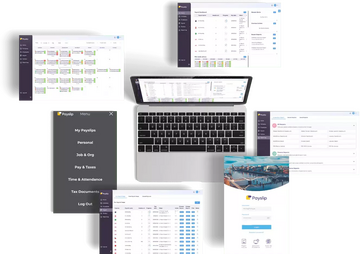
We built the Payslip global payroll control platform to do just that. It collects data from multisource payroll (i.e., your numerous in-country payroll providers), automates the flows of that data and standardizes the information for top-level legibility. Then, it connects payroll software with HR and finance through powerful integrations to create a new level of control and cost visibility.
To learn more, schedule a tour of our platform today.
Images used under license from Shutterstock.com.