

AI is changing what payroll teams can achieve. The next phase of this transformation is agentic AI: systems that can complete defined tasks, coordinate actions and support workflows across business applications.
For global payroll teams, the opportunity is significant. AI agents can reduce repetitive work, accelerate analysis, improve visibility and help payroll professionals focus on the decisions that require their expertise.
At Payslip, we believe AI is central to the future of payroll efficiency. It can help teams prepare reports, identify unusual pay movements, monitor deadlines, support reconciliations and guide users through complex processes. Used well, AI does not remove payroll professionals from the process. It gives them more time, better information and stronger operational support.
The priority is therefore not to slow AI adoption. It is to create the conditions in which organizations can use AI confidently. Clear purpose, structured data, defined permissions and human oversight allow payroll teams to capture the benefits of AI while maintaining the accuracy, accountability and control that global payroll demands.
AI should make payroll teams more efficient, more accurate and more strategic. Governance is what enables that progress at scale.
What are AI agents in payroll?
AI agents in payroll are software-based systems that can interpret a request, use available payroll data and complete a defined task or sequence of tasks.
Unlike a standard chatbot that only returns an answer, an AI agent can support action within a controlled payroll workflow. Depending on its purpose and permissions, an agent could:
- Prepare a payroll report
- Review payroll data for anomalies or unusual movements
- Track missing inputs and unresolved exceptions
- Trigger a defined workflow or route a task for approval
- Support payroll reconciliation
- Summarize payrun activity
- Monitor deadlines and exceptions
- Direct a user to the appropriate next step
AI agents do not need unrestricted autonomy to create value. In payroll, a more effective model is controlled agency: AI completes specific tasks within defined boundaries, while payroll professionals retain responsibility for review, approval and material decisions.
Why AI governance enables adoption
Governance is sometimes presented as a constraint on AI. In practice, good governance is what allows organizations to adopt AI more quickly and with greater confidence.
When teams understand what an AI agent is designed to do, which data it can access, when it must escalate and who approves the outcome, AI becomes easier to test, monitor and scale. These controls also make it easier for payroll, HR, finance, legal, data protection and technology teams to align around a shared operating model.
The regulatory environment around AI is also continuing to develop. Frameworks such as the EU AI Act and the NIST AI Risk Management Framework reinforce the importance of transparency, accountability and trustworthiness in the design and use of AI systems.
Not every payroll use case will be treated in the same way. Requirements will depend on the purpose, design and deployment of the system. Even so, the direction is clear: organizations should know where AI is operating, what it is doing and who remains accountable for the result.
For payroll leaders, this is not only a legal or technology issue. AI governance should become part of the payroll operating model, helping teams move from isolated experiments to repeatable, measurable and trusted AI-enabled processes.
Human-in-the-loop payroll AI
Payslip is strongly supportive of AI in payroll. At the same time, payroll outcomes remain a human responsibility.
A human-in-the-loop approach allows AI to handle repetitive analysis, preparation and task execution while payroll professionals retain authority at critical decision points. This is especially important where an action may affect employee pay, statutory reporting, accounting records or the release of funds.
The objective is not to choose between people and AI. It is to combine the speed and consistency of AI with the judgment, context and accountability of payroll professionals.
In practice, this means AI can prepare, analyze, recommend and route. People review, approve and remain responsible for consequential outcomes.
Six principles for successful AI agents in payroll
A practical governance framework should define what an AI agent can access, what it can do, how its performance is measured and when a person must intervene.
1. Define a specific purpose
Each agent should have a clear payroll use case and a measurable objective. An agent designed to identify unusual pay movements does not need permission to change employee data or approve payroll. Narrow, task-specific use cases are easier to test, improve and scale.
2. Apply role-based data access
AI agents should follow the same least-privilege principles applied to employees and system users. Access should be limited by role, country, entity, data type and task. Permissions should be reviewed regularly so that access remains appropriate as the use case evolves.
3. Keep people at critical decision points
Human approval should remain mandatory for material actions affecting employee pay, statutory reporting, accounting records or payments. AI can accelerate the work that leads to a decision, while payroll professionals retain final authority.
4. Maintain a complete audit trail
Organizations should be able to see what task the agent performed, when it acted, which approved data it used, what output it produced, whether a person reviewed the result and who approved the final action. Auditability supports accountability, operational review and continuous improvement.
5. Test real payroll scenarios and exceptions
AI performance should be evaluated against both standard transactions and the situations that make payroll complex. Testing should include country-specific requirements, retroactive changes, off-cycle payrolls, incomplete inputs and unexpected data formats. The agent should also have a defined escalation route when it cannot continue confidently.
6. Monitor performance and business value
Implementation is the beginning, not the end. Payroll teams should continuously assess accuracy, reliability and value. Useful measures include exceptions correctly identified, false alerts, time saved, recommendations accepted or rejected, tasks escalated for human review and user access changes.
Which payroll tasks are best suited to AI agents?
The strongest starting points are repetitive, high-volume activities where AI can produce a clear output and a payroll professional can review the result before any material action is taken.
Suitable early use cases include:
- Data validation and missing-input detection
- Payroll variance identification
- Pay element mapping recommendations
- Report preparation
- Payrun status summaries
- Deadline and task monitoring
- Reconciliation support
- Policy and process guidance
- Exception routing
These use cases reduce manual workload and help teams move through the payroll cycle faster. As confidence, governance and performance mature, organizations can expand the role of AI while preserving human approval for material decisions.
Why standardized payroll data and processes matter
AI agents depend on the quality, structure and consistency of the information available to them.
Global payroll data often sits across HCM platforms, local payroll providers, spreadsheets, finance systems and country-specific applications. Different naming conventions, file formats and local processes make it harder for AI to interpret information consistently and deliver repeatable results.
A Global-First Data Model creates a stronger foundation by mapping local payroll information into a consistent global structure. A Global-First Process Model brings the same discipline to workflows, actions and approvals while preserving the flexibility required for local country needs.
Together, standardized data and processes improve the quality of AI outputs and make it easier to apply the same controls across countries, entities and providers. They also give payroll leaders greater visibility into workflows, exceptions, approvals and outcomes.
This is why AI readiness and payroll transformation are closely connected. The more consistent and visible the payroll environment, the more effectively AI can support Operational Precision, Global Visibility and Business Agility.
How Payslip supports AI-enabled global payroll
Payslip delivers Payroll Control, Integration and AI Automation for multinational organizations.
Payslip Control is the Global Payroll Control Platform, providing the standardized workflows, calendars, reporting, validations, variance analysis, reconciliations, vendor management and document management that payroll teams use to manage operations across countries.
Payslip Connect automates the flow of payroll data and documents between Payslip Control, HCM and finance systems, payroll providers and other data sources throughout the payroll cycle.
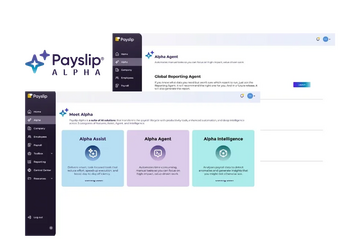
Across the platform, Payslip Alpha brings together AI solutions designed to transform day-to-day payroll operations through Alpha Assist, Alpha Agent and Alpha Intelligence.
This combination provides the operational foundation AI needs: a Global Payroll System of Record, a Global-First Data Model and a Global-First Process Model. Payroll teams can work from standardized information, automate defined tasks, identify exceptions earlier and maintain visibility across countries and providers.
The approach is designed to keep payroll professionals in control. AI supports the work, while defined workflows, permissions, reviews and approvals preserve accountability.
AI insight in action with PayrunIQ
PayrunIQ is a Payslip Alpha Intelligence feature that provides real-time payrun file analysis using natural language questions.
Permissioned users can ask targeted questions about the active payrun and previous pay periods to identify anomalies, run comparisons, perform calculations, analyze trends and check data completeness. Instead of manually inspecting spreadsheets, payroll teams can access focused insight on demand.
PayrunIQ is designed around controlled access. Users only receive answers based on the payroll data they are permitted to access, helping organizations combine faster analysis with appropriate data governance.
The value for payroll teams
Outcome | How AI-enabled payroll supports it |
Operational Precision | Automates routine work and flags exceptions earlier. |
Global Visibility | Delivers consistent insights across global payroll operations. |
Business Agility | Scales standardized processes and AI use cases securely. |
Governance is the foundation for confident AI adoption
AI agents can make global payroll faster, more accurate and more insightful. The organizations that gain the most value will be those that combine ambition with a clear operating model.
Purpose-built use cases, standardized data, role-based access, transparent workflows, continuous monitoring and human oversight create the confidence required to move from experimentation to meaningful adoption.
AI should strengthen payroll control, not replace it. When people remain responsible for critical decisions and AI is applied to the work it does best, payroll teams can increase efficiency without compromising accountability.
Contact Payslip to learn how Payslip Alpha and the Global Payroll Control Platform can support controlled, AI-enabled global payroll operations.
An AI agent in payroll is a software system that can use approved payroll data to complete a defined task or sequence of tasks. Examples include preparing a report, identifying anomalies, monitoring deadlines, supporting reconciliation or routing an exception for review.
AI agents can reduce repetitive manual work, analyze payroll information faster, highlight exceptions and help users move through defined workflows. This gives payroll professionals more time for review, decision-making and strategic work.
AI agents can automate parts of the payroll process, but organizations should retain human oversight for material decisions affecting employee pay, compliance, accounting and payments. The most effective model combines AI-enabled execution with clear human approval points.
Governance defines the agent's purpose, permissions, data access, escalation rules, review requirements and accountability. These controls help organizations adopt AI confidently and expand successful use cases over time.
Organizations should define approved use cases, apply role-based access, keep people at critical decision points, maintain audit trails, test real payroll scenarios and monitor accuracy and business value continuously.
The answer depends on the specific system, its intended purpose and how it is designed and used. Organizations should assess each use case with their legal, data-protection, risk and technology teams.
Good starting points include data validation, anomaly detection, report preparation, payrun summaries, deadline monitoring, reconciliation support and exception routing. These tasks are repetitive, measurable and reviewable.
Standardized data gives AI a consistent structure for interpreting payroll information across countries, entities and providers. This improves the reliability of outputs and makes controls easier to apply at scale.
Payslip combines Payroll Control, Integration and AI Automation. Payslip Control provides standardized payroll operations, Payslip Connect automates payroll data flows, and Payslip Alpha delivers AI assistance, agents and intelligence designed for global payroll.