New platform helps employers prepare for EU Pay Transparency reporting, monitor pay gaps and manage employee Right to Information requests from one centralized platform.
The EU Pay Transparency Directive is changing the way employers across Europe need to understand, analyze and report on pay.
For organizations, meeting these new requirements is not simply a matter of producing another report. It means bringing together payroll and workforce data across countries and entities, defining relevant worker categories, calculating and investigating pay gaps, responding to employee information requests and maintaining the evidence needed to support reporting.
Today, Payslip is introducing Lecora, a purpose-built EU Pay Transparency Reporting Platform designed to help organizations manage these requirements through one structured, repeatable process.
Lecora brings together the data, calculations, workflows and reporting capabilities HR, Total Rewards, Compensation and Benefits, Payroll and Compliance teams need to prepare, report and respond with confidence.
From reporting deadline to continuous readiness
EU Pay Transparency should not become a once-a-year scramble to collect data from different countries, payroll providers and HR systems.
Lecora is designed around a different approach: continuous compliance readiness.
Organizations can bring together the payroll and workforce information required for EU Pay Transparency analysis across countries, entities, systems and providers. Teams can then monitor organization-wide and category-level pay gaps throughout the reporting period, rather than discovering potential issues only when a statutory deadline approaches.
The result is greater visibility into an organization's position and more time to investigate differences, take appropriate action and prepare evidence-based explanations where required.
One platform for two core EU Pay Transparency requirements
Lecora supports two major reporting requirements created by the EU Pay Transparency Directive.
EU Pay Transparency Statutory Reporting
Article 9 introduces gender pay gap reporting requirements for employers.
Lecora brings the required calculations into one reporting environment, supporting both organization-wide and worker category-level reporting using trusted and harmonized payroll data.
Teams can analyze pay gaps across countries, entities and worker categories, investigate differences and prepare the required information for reporting.
Country-specific regulatory reporting capabilities also support the relevant calculations, reporting periods and disclosure rules as national requirements develop.
Employee Right to Information
Article 7 introduces an important new operational requirement for employers: employees' Right to Information.
Lecora provides a dedicated RTI management workflow that helps HR teams manage requests consistently from receipt through to response.
Requests, required calculations and HR review can be managed through a secure and auditable process, helping organizations deliver accurate and timely communication to employees.
Give HR and Rewards teams a clear view of compliance readiness
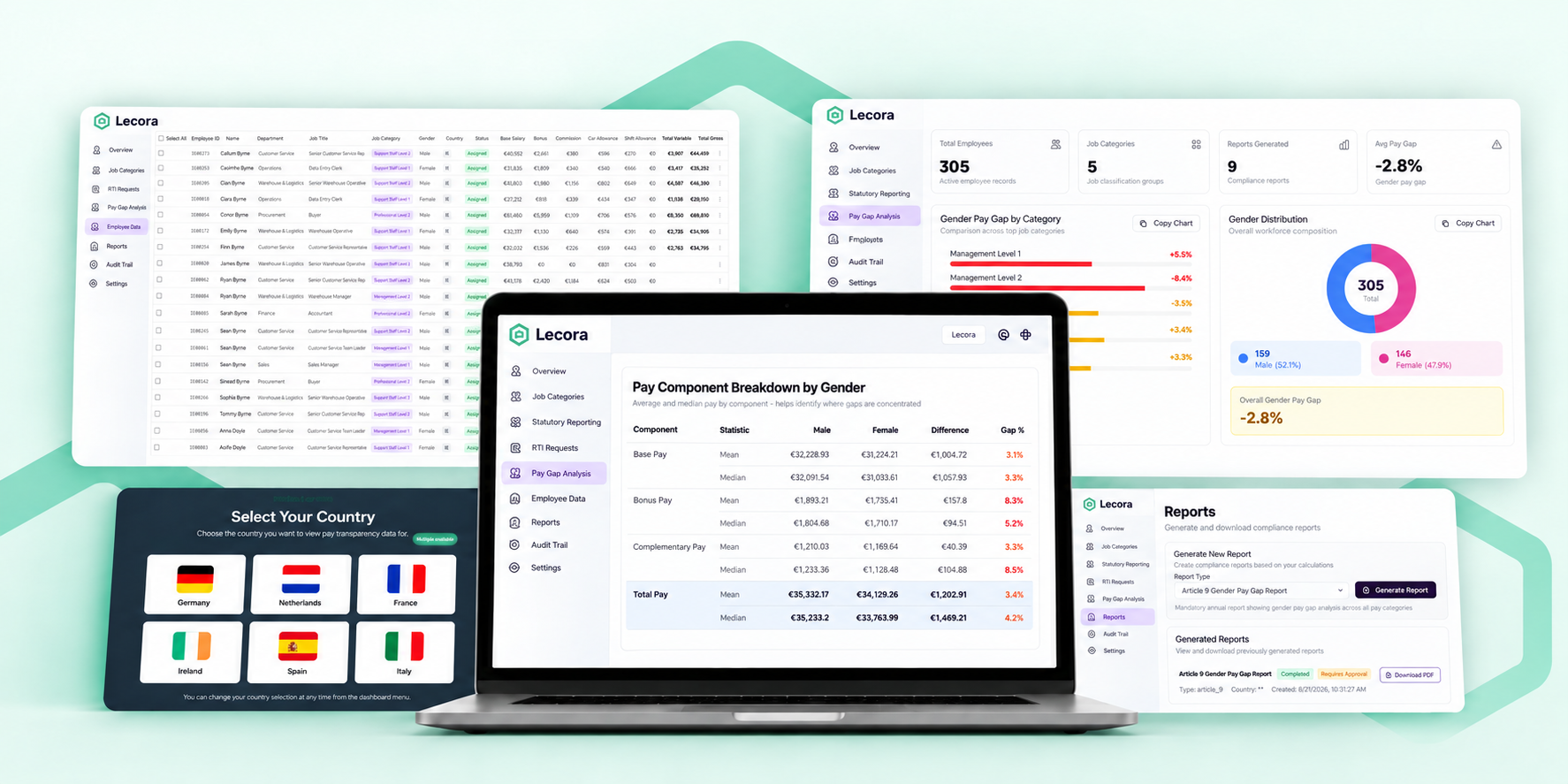
At the center of Lecora is the EU Pay Transparency Compliance Dashboard.
Instead of working through disconnected spreadsheets and reports, HR, Payroll, Reward and Compliance teams can see their organization's readiness from one place.
Teams can drill down from organization-wide results into country, entity, worker category and employee-level detail, helping them understand not only where pay gaps exist, but where further attention may be required.
This allows organizations to identify categories approaching relevant thresholds early enough to investigate, act or prepare an evidence-based explanation.
Built for the practical realities of multinational employers
EU Pay Transparency reporting begins with data.
For a multinational employer, however, that information may be distributed across different countries, legal entities, payroll systems and payroll providers.
Lecora helps consolidate the employee, payroll and pay data needed for EU Pay Transparency analysis in one platform.
From there, teams can create job categories and assign employees performing the same work or work of equal value for analysis and reporting. They can calculate organization-wide and category-level pay gaps and investigate differences across departments, job families, categories and employee populations.
When it is time to report, Lecora enables teams to produce a complete reporting pack containing the required figures and supporting information, ready for review, finalization and export.
Built on Payslip's global payroll foundation
The quality of pay transparency reporting ultimately depends on the quality of the underlying payroll data.
Payslip already helps multinational organizations consolidate payroll information across countries, entities and payroll providers and maintain a reliable global payroll system of record. Payslip's Global-First Data Model standardizes pay data across different local payroll environments, creating the trusted foundation required for global analysis and reporting.
Lecora builds on that foundation specifically for EU Pay Transparency.
This combination helps organizations move away from fragmented data and manual analysis towards a centralized, repeatable approach to pay transparency reporting.
Prepare. Monitor. Respond. Report.
The EU Pay Transparency Directive will require organizations to do more than produce figures.
They will need to understand their pay position, maintain reliable supporting data, manage employee requests and be prepared to explain what their analysis shows.
Lecora brings those activities together.
With centralized data, continuous visibility and structured compliance workflows, HR and Rewards teams can understand where they stand throughout the year and prepare for their reporting obligations with greater confidence.
Know your compliance position. Act early. Report with confidence.
Explore Lecora
Discover how Lecora can help your organization prepare for EU Pay Transparency requirements, manage reporting and employee Right to Information requests, and establish a more structured approach to ongoing compliance.