Global payroll is becoming increasingly connected.
HCM platforms, payroll providers, finance systems, payment processes and other payroll data sources all need to exchange information throughout the pay cycle.
Integration has therefore become fundamental to modern global payroll. But there is another question payroll leaders should be asking:
Who controls those integrations once they are running?
For many organizations, even relatively routine integration activities can still require support from IT teams, external consultants or technology providers.
As global payroll operations become more complex, that dependency can become a bottleneck.
The next stage of payroll integration is not simply greater connectivity. It is giving payroll teams more autonomy over the integrations they rely on every day.
What is payroll integration self-service?
Payroll integration self-service means giving authorized payroll users the ability to monitor and manage routine integration activities without having to raise a support request every time something needs attention.
That can include monitoring incoming data, checking whether an integration completed successfully, triggering selected integrations when required and managing configuration such as mappings and validations.
The objective is not to turn payroll professionals into integration developers. It is to give the people responsible for payroll greater control over the operational technology they depend on.
Why does payroll integration self-service matter?
Timing matters enormously in payroll. If critical data does not arrive when expected, payroll teams need to understand what happened quickly.
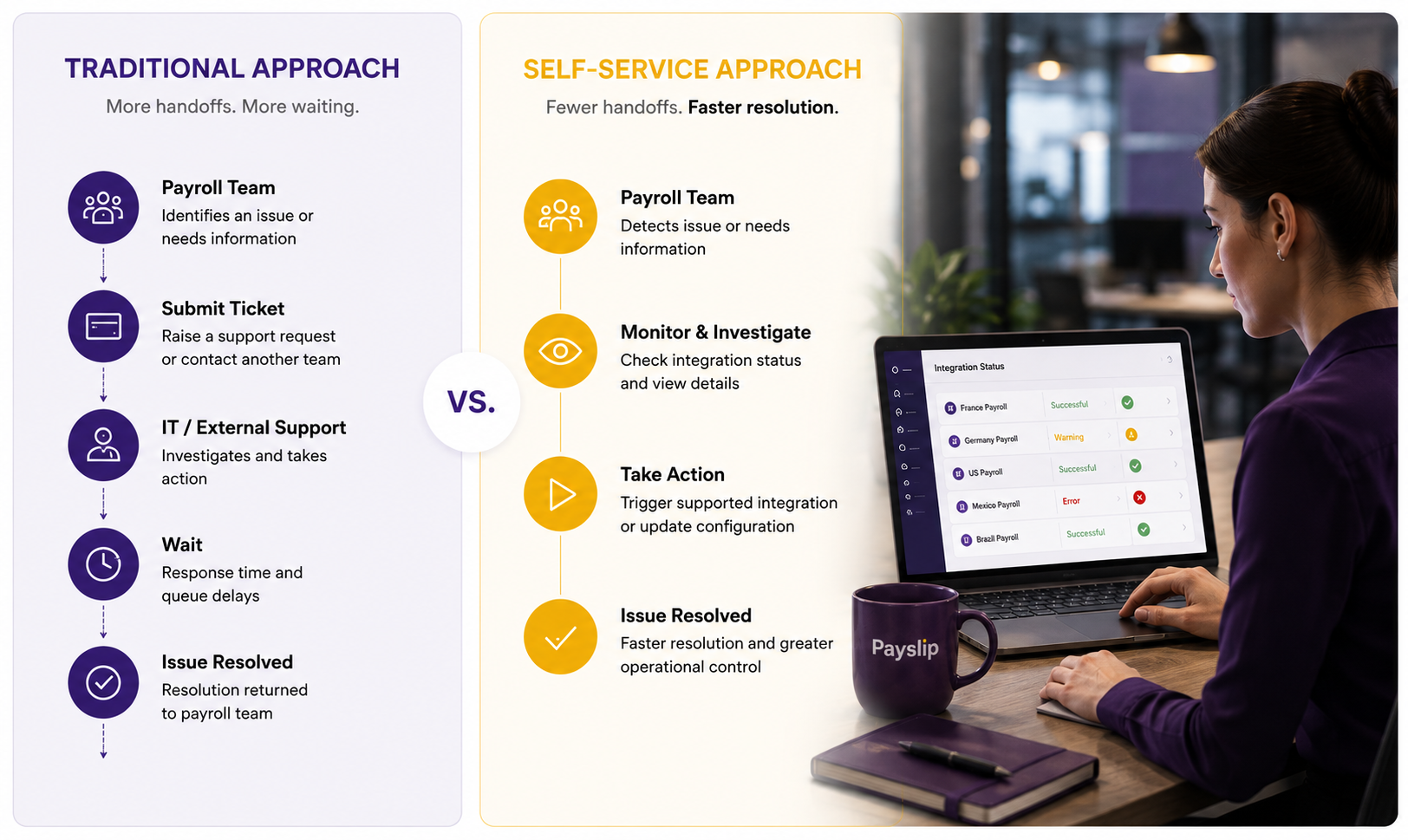
Traditionally, that can mean contacting another team, submitting a ticket and waiting for someone with technical access to investigate.
Every additional handoff introduces time into a process already governed by immovable deadlines.
Giving permissioned payroll users greater visibility and appropriate self-service capabilities can shorten that cycle.
Instead of asking whether an integration ran, the payroll team can inspect its status. Instead of waiting for someone else to rerun a supported integration, an authorized user can initiate the action themselves.
The result is greater operational autonomy and faster issue resolution.
Global payroll needs visibility into data flows
The need becomes even greater for multinational organizations.
Global payroll teams may be managing dozens of payrolls across multiple regions, supported by different systems and in-country providers.
The underlying integration landscape can become substantial. Without centralized oversight, teams can struggle to answer basic operational questions:
- Did the latest HCM data arrive?
- Which payroll experienced an integration warning?
- Did a particular integration complete successfully?
- Does an integration need to be rerun?
- Which validation rules are currently applied?
Payroll teams should not have to investigate multiple systems to find those answers.
The Payroll Integrations Control Center
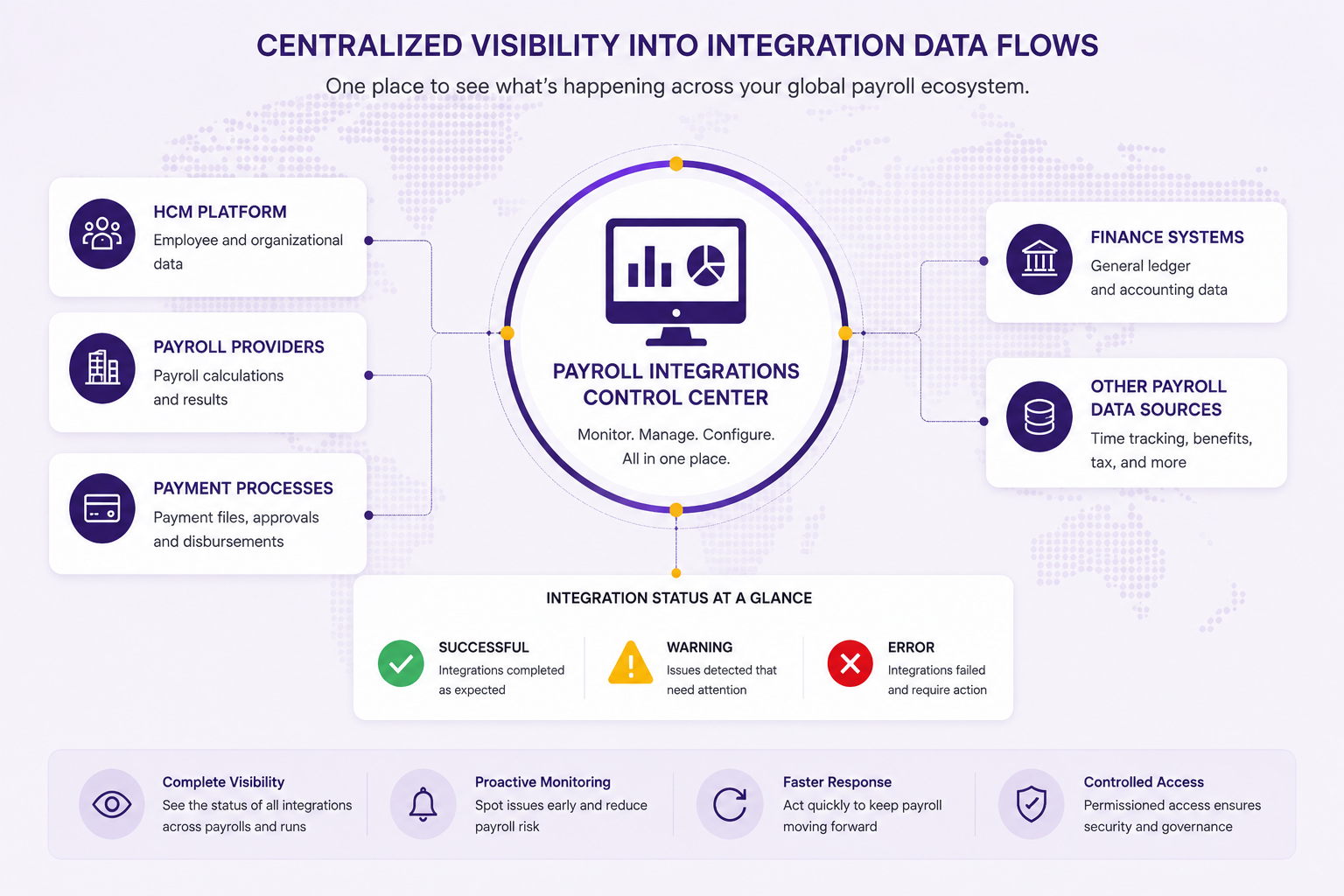
Payslip's Payroll Integrations Control Center, or PICC, is designed to give Employer Key Users a centralized location for managing and configuring payroll integrations.
Permissioned users can monitor HCM integration results and review statuses such as successful, warning or error.
They can also manually trigger selected integrations and monitor execution status by payroll and run.
PICC separates visibility, execution and configuration, helping payroll teams understand what is happening while maintaining controlled access to the actions available to different users.
Configuration matters too
Self-service is not only about rerunning an integration. Payroll data needs to be processed according to clearly defined rules.
PICC enables authorized users to configure areas including Gross-to-Net mappings and validations, payslip validations and General Ledger validations. This is important because payroll operations change.
A validation may need to be adjusted. A mapping may need to evolve. A payroll team may want a particular validation to act as a warning rather than stopping an import.
Giving authorized users controlled access to these configurations can reduce unnecessary dependency while keeping the process governed.
Payroll technology should increase payroll autonomy
Automation is often discussed in terms of eliminating manual tasks. But another important benefit is autonomy.
Technology should enable payroll professionals to manage more of their operation directly. That does not mean removing appropriate controls or technical expertise.
It means ensuring routine operational activities can be handled by the people closest to the payroll process.
As payroll becomes increasingly integrated, the ability to monitor, manage and configure those connections becomes an important part of global payroll control.
For payroll leaders evaluating their technology environment, the question is no longer simply:
"Can our payroll systems integrate?"
It is also:
"How much control does our payroll team have once they do?"