

Global payroll may keep a low profile within an organisation, but it remains one of the most critical business processes. COVID-19 has only served to highlight the business-critical nature of this department and the role it plays when it comes to employee welfare.
As an organisation grows across countries and regions, the workload of completing payroll intensifies with the variations across payroll, tax, and compliance obligations required in each country or region. The variations in compliance filing, payrun deadline and payment schedules during each cycle can impose a constant sense of urgency and criticality on the global payroll process and those global payroll professionals tasked with delivering it.
Handling payroll in one country is a manageable process but becomes complex when a business begins to expand into new countries and regions. If a scalable global payroll management process is not in place, it can cause complications for the management of payroll, both in-house and with external payroll providers.
Internal payroll, HR and Finance departments will likely start receiving a lot of information and status updates for each country and region which needs to be manually aggregated in-house, causing an excess of work for each department during each payroll cycle.
If not already in place, organisations need to create a global payroll system, designed with inbuilt flexibility for expansion into new countries and regions. By delivering a global payroll process that has scalability by design, the global payroll function, whether sitting in HR or Finance, can evolve into an active partner for global expansion and help an organization to scale at a faster pace.
Below, we have mapped out the key areas in which HR, Finance and payroll functions within the business need to develop and understand when scaling the Global Payroll Management Process.
Helping companies to scale
In recent years, the drivers of scalability have changed and increased with the globalization and digitization of multinationals. Multinational companies and are characterized by ambitious growth plans and aggressive go to market strategies design to carve out new opportunities and market share.
There is an increasing need to scale into new countries and territories to sustain such ambitious business models and increase profitability. A global payroll process therefore needs to be an enabler in this scaling process-entities need to be set up quickly overseas under structures need to be in place to enable the rapid hiring, onboarding, and paying of a new number of employees.
All of this needs to be done at pace, while also accounting for country specific nuances such as local tax regulations or other legal implications. Add into the mix local currencies, time zone differences and languages, you are left with a lot of moving parts. This means there is large scope for things to go wrong if multinationals do not pay enough attention to global payroll processing. This is a business-critical department, and it must be supported with the right tools to ensure that it is ready to help with the scaling process.
Understanding the Global Payroll process
The most common payroll system is an operational process which has inputs, reviews to ensure payroll has been processed correctly. It then goes to the payroll provider for the Gross To Net (GTN), it returns to the payroll or finance department to be reviewed and approved. The payroll process then culminates with bank payments, payslip distribution, internal reporting, and external reporting.
The payroll management process may seem simple and straightforward on paper but there are a strong number of internal and external cross-functional deliveries and dependencies throughout the entire process.
There is strong interdependence between all functions within HR, Finance, Payroll departments and their external payroll providers, but there may be only a small number of people within the company that are actually working on the payroll every month as part of a central team.
At the end of the payroll process, there is also a large exposure and dependencies on external providers. Payments need to be made, Payslips need to be distributed and fed through HCM or Employee Self Service (ESS) System. Payroll needs to be internally reported on for General Ledger (GL) and externally, payroll needs to be sent to tax agencies, social security administration and benefits providers.
Understanding of the global payroll process is an important part of preparing a company for scaling activity. If the global payroll department is being tasked with paying the new employees into new countries, then there needs to be a clear understanding of all the operational dependencies associated with it. Rapid scaling is going to be hindered if the global payroll department is not ready- it will need 2 forms of support -firstly investment in innovative technology that can help it to handle the increased complexity that comes with having to pay ever growing numbers of employees spread across different locations. And secondly, a well-planned scalable global payroll model where employers can scale the actual process of payroll instead of the manhours needed to deliver it.
Global Payroll: Developing a process for scale
To enable scaling in a managed sense, especially in the context of short or unplanned scaling, the Global Payroll System needs to be designed consciously with a centrally designed core global payroll management process.
The system to deliver payroll across multiple countries should be a unified platform that allows the key players in global payroll delivery to integrate into one single interface. This way, the global payroll department receive the necessary payroll data inputs from the vendor network along with HCM, HR system and finance imports. This may require an investment in a technology platform, but it will be necessary to future proof mobile payroll delivery in the event of regular scaling activity at a multinational.
Another element of preparing to scale is the standardized workflow practices and data -international payroll teams will have things a lot easier if they're all operating from the same standard workflows and working with similar data formats across countries. This is global payroll standardization in action and will prove to be an essential asset as it enables process scaling across new countries when needed.
In-country processes need to align with a global process and the global process and policies need to dictate the in-country management processes. To have a completely scalable system it needs to be planned centrally and adapted as a playbook when the company scales into a new region.
Be ready to scale
For a global payroll system and process to be ready and prepared to handle all scaling activities, it should ideally have the following features as part of the process:
- Standardized data and workflow processes, that can be easily duplicated in new countries as they are onboarded
- Remote access to data and procedures for all staff processing payroll
- Automated technology to ensure payroll data inputting checking and validation is automated where possible for speed and efficiency
- Employee self-service data and pay related information access
- A global payroll framework that is designed to account for and adapt to local country nuance
- A fully integrated payroll technology platform connected to payroll provider, HCM and finance
- Comprehensive and consolidated real-time multi country global payroll reporting
- Central governance of internal processes, local SMEs, and external vendors
The global payroll system needs to be designed with capacity and redundancy built in for new market setup, operational setup and the operational processes to map into the international payroll processes.
Scale with Payslip
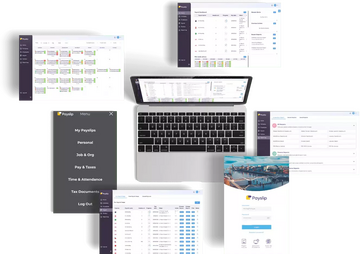
Payslip is the only Integration & Automation platform designed specifically for scalable global payroll management that is designed by workflow and facilitates rapid and efficient business scaling. Payslip enable single system control and visibility of payroll at all stages of the process. The platform was designed with scalability in mind, it helps drive scalability, control and global growth and value by Facilitating repeatable and standardized processes within the global payroll framework.
The platform provides a basis for standardization and a predictable, repeatable process globally, allowing for system memory & team redundancy build. The global payroll team no longer needs to scale, as the business scales. Once a user is familiar with the system, they will be able to process and manage payroll for new countries, thus increasing payroll staff capacity. Payslip helps scale the global payroll system, not the manhours.