

Global workforce solutions aren’t just for large enterprises anymore.
The technology available to small and mid-sized businesses allows those companies to have global footprints, too.
Working on a global scale provides all kinds of new competitive advantages for companies of this size. Their talent pools are so much larger than they would have been a generation ago, as are the number of markets they can target.
But reaching across borders makes doing business much more complicated, as well. Solving that complexity is a technical question.
With that in mind, here are seven global workforce solutions that can help international businesses thrive.
For CRM: Salesforce
Salesforce has been the leading solution for customer relationship management (CRM) for many years, and for good reason. The software is scalable, flexible and intuitive, writes the team at IT consultancy Cyntexa:
“Salesforce can be easily accessed from anywhere, anytime on any device eliminating the necessity for hefty installation and powerful hardware requirements. ... The user-friendly interface of Salesforce makes it an even more preferred choice over its competitors. Furthermore, Salesforce offers customization to make the user interface suit specific customer needs and preferences.”
It’s not hyperbole to say Salesforce has shaped how business gets done today. The company was an early proponent of the idea of customer success and of building data-centric companies.
“There are mission-critical insights locked inside your data that can help you identify trends and opportunities,” Salesforce Lead Solution Engineer Candra McRae says. “Building a data culture is the only way to unearth these buried insights.”
For cloud architecture: Cloudera
The cloud is another one of those core technologies that has allowed smaller businesses to internationalize.
Setting up and managing a cloud architecture for a growing international company, however, can be incredibly challenging. That’s where a company like Cloudera comes in. Cloudera offers a hybrid data platform that leverages public and private clouds to optimize the speed, scalability and security of each client company’s cloud performance.
A hybrid data platform gives growing companies the capacity to scale while remaining agile, writes Joe Rodriguez, Global Financial Services Sector Leader at Cloudera. “It provides a way to accommodate change—for example, by distributing data between cloud and on-premises environments according to its age, sensitivity, frequency of access, the requirements of workloads, and more.”

For team connectivity: GoTo
For global teams where colleagues need to reach each other across borders and time zones, connectivity is crucial. When companies grow beyond what a simple direct messaging tool or conference calling tool can do, they have to seek out robust connectivity solutions like the ones GoTo provides.
GoTo’s solutions support remote and hybrid working with tools to facilitate communication, security and internal support.
That last point is key. In an entirely on-premise working environment, whenever you have a technical problem, you can just ring someone from IT. When your team works remotely or is distributed across multiple regions, IT teams have to do their jobs remotely, too, which can place a real burden on those folks.
“To address this, businesses need a tool that can help IT teams quickly and effectively troubleshoot to minimise infrastructure and network issues and connect with end users when problems arise,” says Mathew Philip, Senior Director and Global Head of GSI Business.
“Products like [GoTo] Rescue allow IT administrators to troubleshoot issues, visualize problems, and communicate with employees effectively.”
For recruiting and hiring: Eightfold
When your talent pool encompasses regions, continents or the whole world, finding the right person for a specific vacancy means processing a lot of data.
That’s the problem Eightfold built its AI-powered talent intelligence platform to solve.
The solution uses deep learning to define roles within the organization and then integrates available data — internal and publicly available external data — to understand what kinds of skills are necessary to succeed in such a role now and in the future.
Thinking along these lines changes hiring entirely. Instead of filling seats, recruiters and hiring managers have a new level of control over the organizational chart. They can chart career paths, forecast future skills needs and help CHROs create more strategic models for workforce deployment.
“The beauty of talent intelligence is that it’s not here to completely replace existing HR systems,” Eightfold Head of Content Molly Brown writes. “It works with almost any HR technology and enhances what is already happening with recommendations based on deep-learning AI.”
For core HR: Workday
When your team is distributed across several countries, the core tasks of human resource management come into sharper focus. Employee onboarding, time-off requests, employee engagement — all of these require a useful solution.
This is why teams choose Workday to manage enterprise HR.
Workday is a financial and human capital management platform that helps companies expand, manage and engage global workforces. AI and machine learning is a core part of the platform, allowing leaders to make faster and better-informed decisions.
The platform’s HR capabilities are made better for the sheer number of platform integrations. Workday Integration Cloud makes it seamless to connect to third-party platforms using over 600 pre-built integrations. And that includes Payslip — the easiest way for Workday customers to solve global payroll. Our platform makes it effortless to completely automate pre-payroll using Workday data, connect with local payroll providers, and then export payslips back into Workday.

For cloud security: Vectra
Securing your cloud is incredibly important and incredibly complex. For many companies, detecting threats, breaches and intrusions in a cloud environment is only possible with AI. Vectra built its Attack Signal Intelligence platform for these kinds of companies.
An example is useful here. A couple of years ago, asset management company Blackstone used the Vectra solution to help migrate Microsoft 365. After performing an initial scan of the Microsoft native tools, Vectra’s team discovered “that hundreds of settings were hidden below the surface, unobserved by the original scan.”
Identifying these kinds of weaknesses is crucial because, as Vectra Senior Technical Marketing Engineer Arpan Sarkar outlined recently, attackers could exploit one Microsoft tenant then move laterally to another to broaden the scope of an attack.
Having a solution like Vectra helps identify such vulnerabilities in your company’s own cloud.
For global payroll control: Payslip
Payroll across borders is likewise complex, but for different reasons. Each country has its own regulations for how workers get paid by their employers. At the same time, payroll data can be extremely useful in executive decision-making — but historically that data is often siloed away, or running a report is too cumbersome or too slow to be useful.
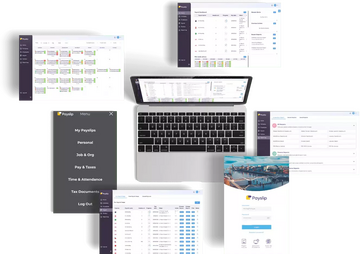
We built the Payslip global payroll control platform to give international companies actual, real-time control over their own payroll data. Global payroll managers can run country-level or international reports in minutes.
Further, Payslip’s platform gives payroll managers the control they need to manage vendors, or the in-country payroll providers. These are the local experts who know how to run payroll in their countries. Ensuring you’re working with the best ICP in each country keeps global payroll running smoothly — and ensures the accurate, timely delivery of paychecks to employees.
To see how Payslip’s automation and integration as a service can transform how you deliver and manage multi-country payroll, book a demo today.
Images used under license from Shutterstock.com.