Mergers and acquisitions can transform a business overnight. Bringing global payroll operations together, however, is rarely as straightforward. Here's how multinational organizations can manage payroll integration after an acquisition without creating unnecessary disruption.
When a company acquires another business, attention naturally turns to financial performance, operational efficiencies, technology integration and future growth. Leadership teams want to understand how quickly the two organizations can begin operating as one.
But while the acquisition may be completed on a specific date, the operational integration can take months or even years. Global payroll is one of the functions where this complexity becomes particularly visible.
The acquiring company may already manage payroll across 20 countries, while the newly acquired business operates in another 15. Some countries overlap, others introduce entirely new jurisdictions, and each organization may have its own payroll providers, HR systems, reporting processes and approval structures.
The immediate priority is clear: employees must continue to be paid accurately and on time. Beyond that, the organization needs to establish how payroll will be managed, monitored and controlled across the combined business.
The challenge is not simply bringing two payroll systems together. It is creating one consistent approach to global payroll management without disrupting the local processes that already work.
Why Payroll Integration Is a Critical Part of Mergers and Acquisitions
Payroll integration after a merger or acquisition is the process of aligning payroll operations, employee data, systems, providers, workflows and governance across the combined organization.
Unlike some business functions, payroll cannot simply pause while integration takes place. Employees still need to be paid, statutory obligations must be met, and local payroll teams must continue operating within established deadlines.
At the same time, the acquiring organization needs to understand what it has inherited. This includes payroll providers, contracts, technology platforms, data structures, local processes and any existing operational risks.
For multinational organizations, this can be particularly challenging because payroll rarely operates through a single system or provider. Different countries may have different payroll arrangements, and those arrangements may have developed independently over many years.
An acquisition introduces another set of processes into an environment that may already be complex.
Without a structured approach, the combined organization can end up with fragmented reporting, duplicated activities, unclear responsibilities and limited visibility into its global payroll operation.
The Hidden Payroll Challenges That Follow an Acquisition
Two Organizations, Different Payroll Operating Models
One of the first challenges is understanding how each organization manages payroll.
The acquiring company may have centralized global payroll governance, standardized workflows and established reporting requirements. The acquired business may rely more heavily on local HR teams, regional finance departments or individual payroll providers.
Neither approach necessarily means payroll is being managed incorrectly. However, combining them without first understanding their differences can create confusion around ownership, approvals and accountability.
For example, one organization may require global payroll approval before payments are authorized, while another may allow local teams to manage the entire process independently.
Deciding how these responsibilities should operate in the combined business requires more than a technology decision. It requires a clearly defined global payroll operating model.
Different Payroll Providers Across the Same Countries
Acquisitions frequently introduce additional payroll providers, sometimes within countries where the acquiring company already operates.
The immediate assumption may be that consolidating providers will simplify operations and reduce costs. In some cases, that may be the right long-term decision. But replacing providers too quickly can introduce additional risks, particularly when local processes are stable and employees are being paid accurately.
Provider transitions involve data migration, testing, contractual considerations, process changes and coordination with local teams. They may also require additional resources during an already demanding integration period.
The more practical question is whether the organization can establish consistent global payroll governance while retaining the providers that meet its operational needs.
Global payroll standardization does not necessarily require global payroll provider consolidation.
Inconsistent Employee and Payroll Data
Data is another major integration challenge.
Two organizations may use different HR systems, employee identifiers, pay element definitions, cost centre structures and payroll reporting formats.
Even when the underlying information is similar, the way it is recorded and categorized may differ considerably.
For example, a particular compensation element may be classified differently across countries or organizations. If those differences are not understood, consolidated reporting may produce an incomplete or misleading picture of workforce costs.
This becomes especially important when Finance and HR need reliable information about the combined workforce, including salary costs, employer contributions, bonuses and other compensation-related expenses.
Creating consistent data definitions and reporting structures is therefore an important part of post-acquisition payroll integration.
Limited Visibility Across the Combined Business
After an acquisition, leadership teams often want a consolidated view of payroll costs, headcount and operational performance.
But if the two organizations use different providers, systems and reporting processes, producing that view can require substantial manual effort.
Global payroll teams may need to collect reports from multiple sources, standardize the information and reconcile differences before presenting the results to Finance or senior management.
This can make it difficult to answer important questions. How much is the combined organization spending on payroll? Which countries have the highest employer costs? Where are payroll processes creating operational risks? Are all payrolls being completed and approved on schedule?
Without consistent global reporting, these questions become harder to answer precisely when the business needs reliable information to support integration decisions.
Why Rushing Payroll Consolidation Can Create More Problems
During a merger or acquisition, there is often pressure to demonstrate efficiencies quickly. Reducing the number of systems and suppliers can appear to be an obvious opportunity.
However, payroll is an area where speed needs to be balanced with operational stability.
Moving an acquired business onto a new payroll provider or platform without sufficient preparation can create challenges involving historical data, payroll calculations, local requirements and employee payments.
A more effective approach is to distinguish between standardizing global payroll management and changing local payroll delivery.
An organization can introduce consistent workflows, reporting, approvals and governance without immediately replacing every local payroll provider.
This allows the combined business to improve visibility and control while evaluating which provider or system changes will genuinely deliver long-term value.
It also gives payroll teams time to understand local requirements, identify dependencies and plan any necessary transitions properly.
Five Priorities for Global Payroll Integration After an Acquisition
1. Build a Complete Picture of the Existing Payroll Environment
Before making changes, organizations need to understand how payroll currently operates across both businesses.
This means identifying the countries and entities involved, payroll providers, HR systems, payment arrangements, reporting requirements and existing processes.
It is equally important to establish who owns each activity and where dependencies exist between Payroll, HR, Finance and external providers.
A comprehensive assessment creates the foundation for informed decisions rather than assumptions about what should be consolidated or replaced.
2. Protect Payroll Continuity During the Transition
Employees should not experience unnecessary disruption because their employer has completed an acquisition.
Maintaining payroll continuity means ensuring that existing processes remain operational while changes are assessed, tested and introduced.
Clear responsibilities, documented deadlines and escalation procedures are essential during this period. Organizations should also understand which payroll activities depend on systems, individuals or providers that may be affected by the integration.
Any proposed changes should be evaluated against their potential impact on payroll accuracy, payment timing and local compliance requirements.
3. Establish Consistent Global Payroll Governance
Once the existing environment is understood, the organization can begin aligning how payroll is managed across the combined business.
This may involve introducing consistent approval processes, defined responsibilities, standardized reporting and common controls.
The objective is not to eliminate every local difference. Country-specific requirements will always influence payroll delivery.
Instead, global governance should provide a consistent framework that allows leadership to understand how payroll is operating, where risks exist and who is accountable for resolving them.
4. Standardize Payroll Data and Reporting
Reliable payroll reporting becomes increasingly important during post-acquisition integration.
Organizations need consistent definitions, data structures and reporting processes to understand workforce costs across the combined business.
Standardizing payroll data can help reduce manual consolidation, improve comparability and provide Finance and HR with more reliable information.
It also creates a stronger foundation for future analytics, automation and operational improvements.
5. Make Provider Consolidation a Strategic Decision
Reducing the number of payroll providers may offer benefits, but it should not automatically be the first step.
Organizations should evaluate providers based on operational performance, local expertise, service quality, costs, integration capabilities and business requirements.
Some providers may be well suited to the combined organization's future needs, while others may need to be replaced or consolidated over time.
The key is to make these decisions based on evidence rather than assuming that fewer providers will always result in a better global payroll operation.
How Payslip Supports Global Payroll Integration After an Acquisition
For multinational organizations managing mergers and acquisitions, one of the biggest challenges is creating global payroll consistency without introducing unnecessary disruption to existing local operations.
Payslip's Global Payroll Control Platform helps organizations address this challenge by providing a centralized approach to managing payroll across countries, entities and providers.
Through its Bring Your Own Payroll (BYOP) model, Payslip allows organizations to retain their existing in-country payroll providers while establishing consistent global processes and oversight. This can be particularly valuable after an acquisition, when the combined business may inherit multiple providers and different local payroll arrangements.
Rather than requiring an immediate provider replacement programme, Payslip enables organizations to focus on standardizing how payroll is managed.
With Digital Workflows and Calendars & Alerts, global payroll teams can coordinate activities, establish clear responsibilities and monitor deadlines across the combined organization. This helps create consistency even when local providers continue operating under different country-specific requirements.
Payslip's Automated Validations, Variance Analysis and Smart Reconciliations support payroll data quality and control by helping teams identify discrepancies and investigate differences throughout the payroll cycle. These capabilities become particularly valuable when organizations are bringing together payroll information from different sources and processes.
Reporting & Analytics provides a consolidated view of global payroll information, helping Payroll, HR and Finance teams access more consistent data across countries and entities. Meanwhile, Vendor Management supports coordination with in-country payroll providers and greater visibility into their performance.
Bringing AI into Post-Acquisition Payroll Integration with Payslip Alpha
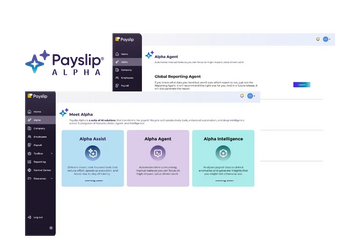
AI is also opening new opportunities to simplify global payroll integration following mergers and acquisitions. With Payslip Alpha, Payslip is introducing AI-powered intelligence and agentic workflows to help global payroll teams reduce repetitive manual tasks, identify discrepancies more efficiently and manage complex payroll operations with greater visibility and control.
When two organizations bring together different payroll providers, data structures and operational processes, these capabilities can support a more streamlined approach to managing exceptions, reviewing information and coordinating activities across the combined business. By combining AI with Payslip's centralized payroll data and established controls, organizations can work towards a more intelligent and efficient global payroll operating model without compromising the flexibility of their existing local payroll arrangements.
As a global payroll system of record, Payslip brings payroll information, workflows and controls into a centralized environment. This allows organizations to strengthen governance across an expanding international footprint while maintaining the flexibility required for local payroll delivery.
For businesses navigating acquisitions, the benefit is the ability to improve global payroll control without making every local provider transition a prerequisite for progress.
Building a Stronger Global Payroll Operation After an Acquisition
Mergers and acquisitions create opportunities for growth, market expansion and operational improvement. They also introduce complexity, particularly when two established payroll environments need to operate within one organization.
The temptation may be to focus immediately on consolidating systems and providers. But successful global payroll integration starts with understanding the existing environment, protecting payroll continuity and establishing clear governance.
With consistent processes, reliable data, centralized visibility and emerging AI-powered capabilities, multinational organizations can manage the transition more effectively, reduce manual complexity and make better-informed decisions about their future payroll operating model.
The goal is not simply to combine two payroll operations. It is to build a stronger, more efficient and more controlled global payroll function that can support the next stage of business growth.
Because a successful acquisition brings businesses together. A successful global payroll strategy helps them operate as one.
Discover how Payslip's Global Payroll Control Platform helps multinational organizations standardize global payroll management, maintain visibility across providers and strengthen payroll control as their businesses grow.
See Payslip in action! Book a demo with one of our team members.