What happens if the one person who understands a country's payroll process is suddenly unavailable?
It sounds like a simple question.
For many multinational payroll teams, it exposes a significant operational risk. Global payroll knowledge can become highly concentrated.
One person knows the spreadsheet. Another knows which file the local provider needs. Someone else knows that a particular payroll needs an additional check three days before cutoff. The payroll gets delivered every month because experienced people know what to do. Until one of them isn't there.
This is why global payroll business continuity should be part of every payroll leader's operating model.
What is payroll business continuity?
Payroll business continuity is the ability to maintain accurate and timely payroll operations when normal people, processes or circumstances are disrupted.
That disruption does not need to be a major disaster.
It could be:
- an unexpected absence
- an employee leaving the organization
- a payroll provider change
- rapid international expansion
- an internal restructuring
- a system issue
- a sudden increase in workload
The key question is whether another authorized person can understand the payroll process and continue the work without relying on undocumented knowledge.
The key-person dependency problem
Local payroll expertise is extremely valuable. But there is a difference between expertise and dependency. If the process exists primarily in someone's memory, the organization has a continuity risk.
This becomes particularly significant in global payroll because country processes can develop independently over time. Different team members may use different trackers, folders, email processes and naming conventions.
Each local payroll can work successfully while the global organization lacks a consistent operating model. The problem often remains invisible until something changes.
Standardized payroll processes reduce dependency
One way to reduce key-person dependency is to standardize the underlying payroll process.
Payslip's Global-First Process Model applies standardized processes across entities while allowing flexibility for country-specific requirements.
Within Payslip Control, Digital Workflows organize payroll activities into defined steps and actions. Actions have owners, due dates and statuses. This creates a visible operating process rather than one that depends primarily on individual knowledge.
If a team member is unavailable, another authorized user has a much clearer picture of where the payroll stands, what has already happened and what needs to happen next.
Calendars turn deadlines into shared operational knowledge
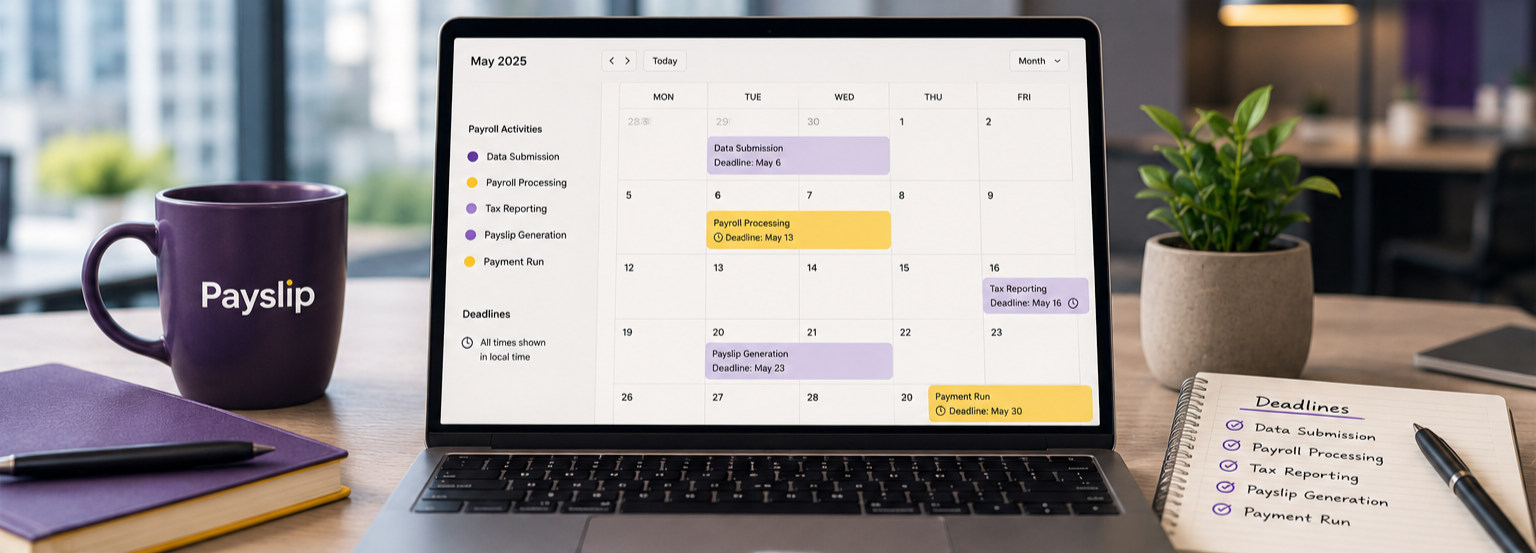
Payroll calendars are another important part of continuity.
When critical dates live in personal calendars or spreadsheets, access to those deadlines can disappear with the individual maintaining them.
A centralized payroll calendar creates shared visibility.
Payslip Control's Calendars & Alerts provide payroll timelines and due dates across payrolls, with notifications for relevant users when deadlines approach or actions become overdue. That helps transform payroll timing from personal knowledge into organizational knowledge.
Documentation needs continuity too
Payroll also generates a substantial number of files and documents.
Inputs, Gross-to-Net calculations, payslips, tax documents, General Ledger information, payment files and supporting documentation all need to remain accessible to the appropriate people.
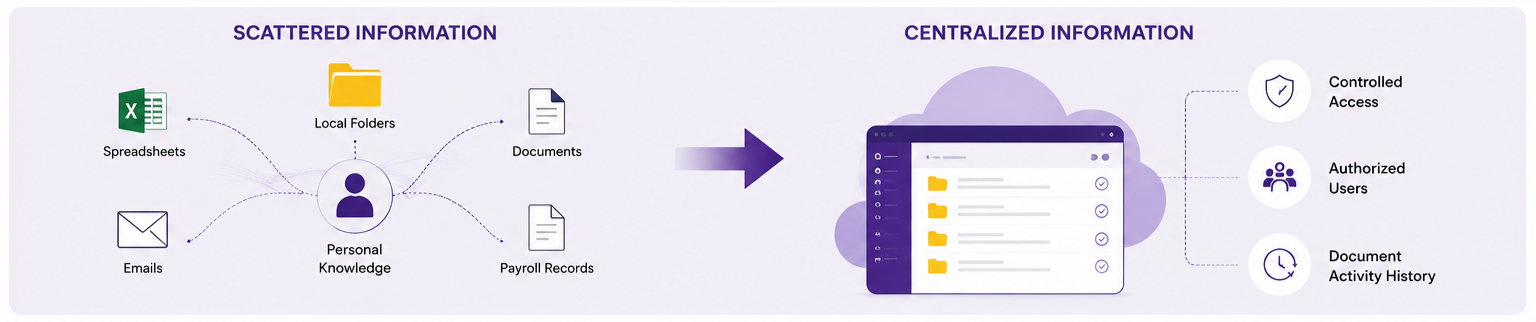
Centralized document management helps authorized users find the information required to understand what happened during a payroll cycle.
Payslip Control's Document Management capability provides centralized repositories for payroll documentation with access controls and histories of document activity. That supports both continuity and audit readiness.
Vendor processes should not depend on individual relationships
Many global organizations work with multiple in-country payroll providers, and those local relationships are valuable.
But operational continuity becomes more difficult when the way a provider works with the organization depends entirely on one internal contact.
Standardized workflows create a common process for the employer and its payroll providers. That does not replace local expertise or the relationship with the provider. It provides a consistent operational framework around those relationships.
Business continuity is ultimately about resilience
Payroll is business-critical. Employees still need to be paid when someone is sick, leaves the company or when the organization changes.
The strongest payroll operations therefore do not depend solely on talented individuals knowing what to do.
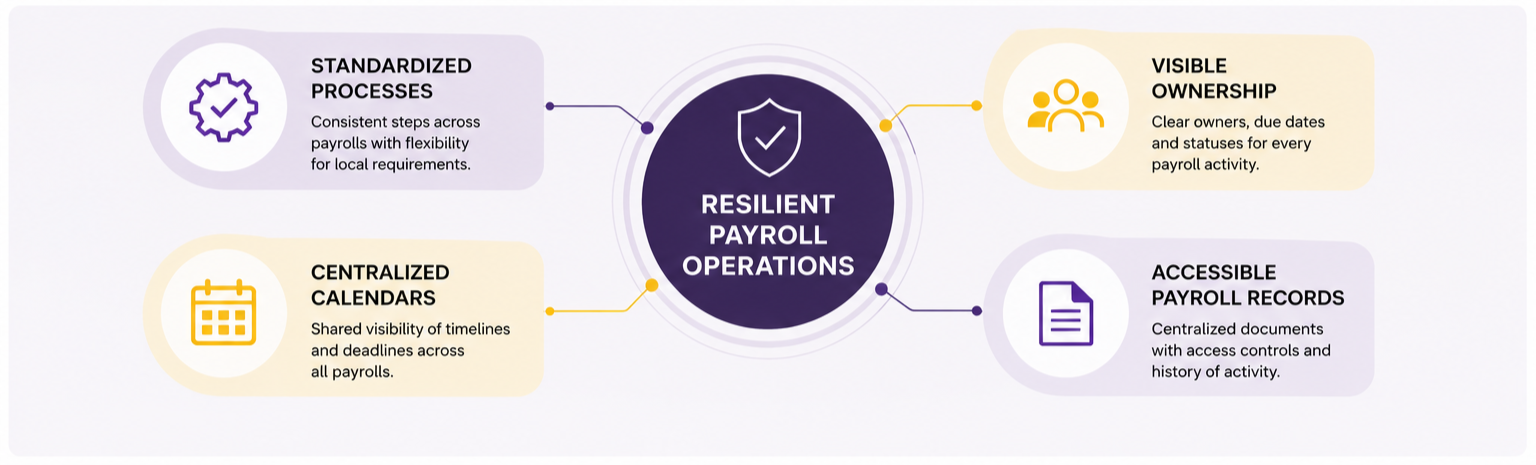
They capture that knowledge through standardized processes, visible ownership, centralized calendars and accessible payroll records.
The goal is not to make payroll people interchangeable. Their expertise remains essential.
The goal is to ensure the organization can continue operating when circumstances change.
For global payroll leaders, that makes business continuity more than a contingency plan. It is a measure of how resilient the payroll operating model really is.