

Last updated in September 2023.
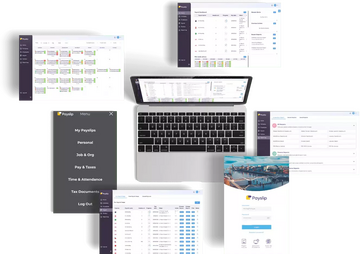
Payslip Global Payroll Control Platform automates pre-payroll through to post-payroll delivering local flexibility within global standardization.
Australia is the world's sixth-largest country by total area and is a federal parliamentary constitutional monarchy.
The Australian economy is one of the largest mixed-market economies in the world. It is known for its abundance of natural resources, such as minerals and metals, agriculture, and a strong service sector.
Australia has a highly developed market economy and one of the highest per capita incomes globally. The country is a regional power and has the world's thirteenth-highest military expenditure.
Payroll in Australia – 2023 Updates
Here is a list with the new initiatives incorporated in this year's Individual tax return instructions:
- Removing the self-education expenses threshold
Before 1 July 2022, you were required to reduce your allowable work-related self-education expenses by $250 to calculate your deduction.
The $250 non-deductible threshold has been removed from the 2022–23 income year. The changes will also apply to the fringe benefits tax (FBT) year starting on 1 April 2023.
- Working from home
The fixed rate method for calculating your deduction for working from home expenses has been revised.
The revised fixed rate method is $0.67 per work hour and is available from 1 July 2022.
- Low and middle income tax offset
The low and middle income tax offset (LMITO) ended on 30 June 2022. It is not available for the 2022–23 income year.
- Veterans' super (invalidity pension) tax offset
The veterans' superannuation (invalidity pension) tax offset (VSTO) is a non-refundable tax offset. This tax offset ensures veterans and their beneficiaries don't pay more tax because of the Douglas court decision. It applies from the 2007–08 income year.
Australian Payroll – Basic Facts
The official currency is the Australian dollar (AUD or AU$).
The Australian Taxation Office, known as the ATO, is the revenue collection agency section of the Australian Government. The ATO introduced one of the latest large-scale changes to Australian payroll through Single Touch Payroll (STP). The ATO is also responsible for many taxation and superannuation support systems for all Australians.
All companies are required to obtain an Australian Business Number (‘ABN’) and Tax File Number (‘TFN’) from the ATO where they are carrying on business or employing staff in Australia.
Taxation is calculated in line with the ATO tax rates and is based on whether the employee is a resident or not. Employees can claim various reductions or additions through the payroll.
If the company is a large remitter of taxation, they are required to pay taxes to the authorities within 7 days of the funds being withheld from the employee. Otherwise, the taxes get paid monthly by the 21st of the following month.
Employers are required to pay superannuation (SA) for employees which must be paid to the authorities by the 28th of the month following/ subsequent to each quarter.
It is not mandatory to make payments to employees or the authorities from an in-country bank account.
The standard tax year in Australia runs from 1st July to 30th June.
Tax and Social Security Considerations
Single Touch Payroll (STP)
Single Touch Payroll (STP) is an Australian Government initiative to streamline employers' reporting to government agencies.
With STP you report employees' payroll information each time you pay them through STP-enabled software. Payroll information includes:
- salaries and wages
- pay as you go (PAYG) withholding
- superannuation liability information.
Learn how it works on the ATO website here.
Corporate Tax
The full company tax rate of 30% applies to all companies that are not eligible for the lower company tax rate. Eligibility for the lower company tax rate depends on whether you are a base rate entity from the 2017–18 income year and onwards.
Income Tax
The tax-free threshold in Australia is AUD18,200.
Australian income tax rates for 2023–24 and 2022–23 for residents:
Income thresholds |
Rate |
Tax payable on this income |
$0 – $18,200 |
0% |
0 |
$18,201 – $45,000 |
19% |
19c for each $1 over $18,200 |
$45,001 – $120,000 |
32.5% |
$5,092 plus 32.5c for each $1 over $45,000 |
$120,001 – $180,000 |
37% |
$29,467 plus 37c for each $1 over $120,000 |
$180,001 and over |
45% |
$51,667 plus 45c for each $1 over $180,000 |
* These rates do not include the Medicare levy of 2%
A simple tax calculator is available on the ATO website to help you calculate the tax on your taxable income.
Payroll Tax
When paying payroll tax in Australia, it’s referred to as Pay As You Go (PAYG). It’s this PAYG system that allows for the withholding of tax from the employee being paid to the ATO.
Payroll tax is a self-assessed, general-purpose state and territory tax assessed on wages paid or payable by an employer to its employees, when the total wage bill of an employer (or group of employers) exceeds a threshold amount. Australian payroll tax is calculated on scale based on hours worked and the income generated over that period.
From 1 July 2023, the payroll tax rate is 5.5% on the taxable wages paid by employers or groups of employers. A diminishing threshold will apply for employers or groups of employers with annual taxable wages in Australia between $1 million and $7.5 million.
Sales Tax
The goods and services tax (GST) in Australia is a value added tax of 10% on most goods and services sales, with some exemptions (such as for certain food, healthcare, and housing items) and concessions (including qualifying long-term accommodation).
Withholding Tax
If you are a foreign resident, tax is generally withheld in Australia from interest, unfranked dividends, and royalties you earn in Australia. Some agreements provide an exemption from withholding tax in certain circumstances.
- Interest - 10%
- Dividends - Dividends can be franked or unfranked. Franked dividends are profits that the company has already paid tax for at the Australian company tax rate of 30% before distributing dividends. Because tax has already been paid, the shareholder can claim a credit when calculating their tax liability.
- Royalties - 30%
Federal Insurance Contributions Act (FICA)
FICA is often referred to as payroll tax because typically employers deduct FICA tax from employee paychecks and remit the money to the IRS on behalf of the employee.
FICA tax includes a 6.2% Social Security tax and 1.45% Medicare tax on earnings.
Social Security Tax Rate (6.2%) + Medicare Tax Rate (1.45%) = FICA Tax Rate (7.65%)
Social Security tax - 6.2%. Frequently labeled as OASDI (it stands for old-age, survivors and disability insurance), this tax typically is withheld on the first $147,000 of your wages in 2022. Paying this tax is how you earn credits for Social Security benefits later.
Medicare tax - 1.45%. Sometimes referred to as the “hospital insurance tax,” this pays for health insurance for people who are 65 or older, younger people with disabilities and people with certain conditions. Employers typically have to withhold an extra 0.9% on money you earn over $200,000.
FICA tax rates and limits.
| Employee pays | |
|---|---|
| Social Security tax (aka OASDI) | 6.2% (only the first $147,000 in 2022; $160,200 in 2023). |
| Medicare tax | 1.45%. |
| Total | 7.65%. |
| Additional Medicare tax | 0.9% (on earnings over $200,000 for single filers; $250,000 for joint filers). |
There are no social security taxes in Australia. However, a levy is imposed on taxable income and reportable fringe benefits of residents for the funding of a National Health Scheme (Medicare). The Medicare levy is currently 2%. No levy is payable by those with taxable income below the relevant low income thresholds.
Superannuation (or Super)
This is how Australian workers grow their retirement and pension values for the future. Employers are legally required to make payments on the employee’s behalf to a nominated superannuation account. The current rate of Super is 11%. Superannuation must be paid to the authorities by the 28th of the month following/subsequent to each quarter and is paid to the employee’s account before tax is taken from wages.
A sweeping array of changes to Australia’s superannuation regime are on the horizon with some coming into effect from 1 July 2023. The latest superannuation changes include:
- an increase in the superannuation guarantee rate;
- the imposition of the new payday super measures;
- increasing the visibility of the Australian Taxation Office (ATO) over unpaid super;
- enhancing the ATO’s unpaid superannuation recovery targets;
- the reduction of tax concessions for individuals with more than $3 million in super
- a change in the jurisdiction of the Australian Financial Complaints Authority (AFCA) to provide for it to hear superannuation related complaints; and
- the potential creation of more impact investment opportunities for super funds.
Fringe Benefit Tax (FBT)
Fringe benefits are non-cash benefits for the employee during their employment. It can be for items such as private health insurance, company car, loan or other items allowing the employee to do their job. The FBT rate is 47% of the determined grossed-up taxable value of the benefit provided. The FBT year of coverage runs from April 1st to March 31, which differs from the financial year.
Capital Gains Tax (CGT)
If you sell a capital asset, such as real estate or shares, you usually make a capital gain or a capital loss. This is the difference between what it cost you to acquire the asset and what you receive when you dispose of it.
You need to report capital gains and losses in your income tax return and pay tax on your capital gains. Although it’s referred to as capital gains tax (CGT), this is actually part of your income tax, not a separate tax.
The amount of CGT you will pay on your shares can vary depending on how long you have held the investment. If you own the asset for less than 12 months, you will have to pay 100% of the capital gain at your income tax rate. If you own the asset for longer than 12 months, you will pay 50% of the capital gain.
Compensation and Benefits
Minimum wage
Effective from 01 July 2023, the national minimum wage increased from $21.38 to $23.23 per hour and $812.44 to $882.80 per week.
Working hours
The maximum workweek is 38 hours.
Overtime
Overtime pay rates typically are based on a percentage system. There are penalty rates which are paid for work done outside usual hours.
Public Holidays
In Australia, there are 8 national public holidays observed as part of the National Employment Standards (NES) that underpin employment throughout the country. Here is the full list.
Leave
Full-time employees are entitled to four weeks of paid annual leave each year.
- Holiday allowance: Paid days off on public holidays unless it’s reasonable to ask the employee to work.
- Annual leave: 4 weeks paid leave per year, plus an extra week for some shift workers.
- Community service leave: Up to 10 days paid leave for jury service (after 10 days is unpaid) and unpaid leave for voluntary emergency work.
- Medical Leave: Includes 10 days paid personal (sick)/ caregiver’s leave, 2 days unpaid caregiver’s leave and 2 days compassionate leave as needed.
- Parental leave: Paid parental leave is 18 weeks paid at the national weekly minimum wage rate, rounded up to the nearest multiple of $1, if they are the primary caregiver of a newborn or adopted child. Employees also are entitled to 12 months of unpaid parental leave.
- Long-service leave: Employees who have worked for the same employer for an applicable number of years may be entitled to paid long-service leave.
- Jury-duty leave: For each time employees are summoned for jury selection and potential jury duty, they must be paid an applicable amount for the first 10 days of jury selection and jury duty.
- Family and domestic violence leave: Up to 5 days of unpaid leave to deal with family and domestic violence.
- Voluntary emergency-management leave: Employees are entitled to unpaid leave to volunteer in emergency-management capacities in response to natural disasters or other emergencies.
Wage Payment
Most employees are paid monthly, biweekly, or weekly, either via electronic funds transfer, paper check, or cash. Payslips are required and must be provided within 1 working day of wages being paid. They may be provided electronically.
Bonuses and Special Benefits
In Australia there is a Work Bonus which is an initiative to help older Australians access the benefits of working while getting a pension. The Work Bonus reduces the amount of employment income or eligible self-employment income that we apply to the income test.
You can get the Work Bonus if all of these apply to you:
- you’re over Age Pension age
- you get a pension that’s not the Parenting Payment single
- you’re not getting the transitional rate of pension.
Termination of Employment
Employers must provide employees with a minimum period of termination notice or pay instead of notice, as follows:
- employed > 1 year = 1 week of notice
- employed < 1 ≤ 3 years = 2 weeks of notice
- employed < 3 years ≤ 5 years = 3 weeks of notice
- employed < 5 years = 4 weeks of notice.
Workers’ Compensation
Each state government regulates the workers compensation scheme in that state. The various schemes are administered in different ways and insurers may have different roles within the schemes.
Record Keeping
All employment-related records (including tax records) generally must be kept for a minimum of 7 years.
Foreign Workers in Australia
Visas
Unless you are an Australian or New Zealand citizen, you will need a valid Australian visa to enter the country. New Zealand passport holders can apply for a visa upon arrival in the country. All other passport holders must apply for a visa before leaving home. You can apply for a range of visas, including tourist visas and working holiday visas, at the nearest Australian Embassy or Consulate. The most common way for foreign workers to enter the country is through the Temporary Skill Shortage (TSS) visa, which will allow employers to sponsor skilled overseas workers for occupations approved by the government.
The visa-waiver program for business visitors allows Australians to travel to the US for 90 days or less for business-specific purposes without having to obtain a B-1 business visa. Stays longer than 90 days require a visa.
Taxes
Temporary residents (who possess a temporary resident visa) generally are treated as non-residents with only Australian sourced income being subject to tax in Australia. Foreign-source income is not taxed and the attribution rules do not apply.
Here is a quick look at the Australian tax brackets for non-residents:
| Non-resident Tax scale 2022-23 | |
|---|---|
| Taxable income | Tax on this income |
| $0 – $120,000 | 32.5c for each $1 |
| $120,001 – $180,000 | $39,000 + 37c for each $1 over $120,000 |
| $180,001 and over | $61,200 + 45c for each $1 over $180,000 |
Non-residents do not pay the Medicare Levy.
Treaties
Australia has entered into more than 50 income tax treaties, including an income tax treaty with the United States. Australia also has a totalization agreement with the United States for social tax coverage purposes.
Australia currently has 10 free trade agreements in force with China, Japan, Republic of Korea, New Zealand, Singapore, Thailand, US, Chile, the Association of Southeast Asian Nations (ASEAN) (with New Zealand) and Malaysia. Australia concluded negotiations of the Trans-Pacific Partnership Agreement in October 2015.
Need local country payroll partners?
Payslip can connect you with payroll providers in more than 200 countries who are already onboarded and connected to our global payroll control platform.