Agentic AI is bringing a new level of intelligence to global payroll operations. From detecting anomalies and streamlining reconciliations to supporting smarter workflows, organizations can already use AI to reduce manual work, improve accuracy, and strengthen payroll control.
Imagine starting your working day and discovering that your global payroll platform has already identified an unusual variance in one country, highlighted missing employee information in another, and prepared a consolidated report for your review.
Instead of spending hours searching through spreadsheets, chasing payroll providers, and comparing data across systems, your team can focus on the exceptions that genuinely require attention.
This is the value of intelligent, AI-powered global payroll operations today.
Artificial intelligence is helping payroll professionals automate tasks, analyze data, and identify discrepancies. Agentic AI builds on these capabilities by enabling intelligent systems to work toward defined objectives, coordinate multiple steps, and support decisions throughout the payroll cycle.
But payroll is not an ordinary business process. Accuracy, compliance, security, and accountability are essential.
The question is no longer simply whether AI has a role in global payroll. It is how organizations can put intelligent automation to work while maintaining the visibility, governance, and human oversight that payroll demands.
What Is Agentic AI in Global Payroll?
Agentic AI refers to artificial intelligence systems designed to pursue defined goals by planning, coordinating, and executing tasks within established rules and permissions.
Unlike traditional automation, which follows predefined instructions, agentic AI can evaluate information, determine appropriate next steps, and adapt its actions based on changing circumstances.
In global payroll, this means moving beyond individual automated tasks toward more connected, intelligent workflows that support payroll operations.
Depending on the system's capabilities and permissions, an agentic payroll workflow can:
- Monitor payroll data for missing information or unusual changes.
- Identify potential issues before payroll deadlines.
- Gather relevant information from connected systems.
- Prepare exception reports for payroll teams.
- Recommend corrective actions based on predefined rules.
- Trigger authorized workflows and escalate issues requiring human review.
The important distinction is that agentic AI does not mean removing human control from payroll processing.
In a high-stakes environment such as payroll, the greatest value comes from combining intelligent automation with clear human oversight.
The goal is not to remove payroll professionals from the process. It is to reduce administrative work so they can concentrate on accuracy, compliance, and strategic decision-making.
Why Traditional Payroll Automation Is No Longer Enough
Global payroll teams have made significant progress in automating repetitive activities.
Data transfers, validations, approval workflows, and payroll reconciliations can now be handled more efficiently through modern payroll technology.
However, global payroll operations remain complex.
An organization operating across 30 countries may work with numerous local payroll providers, each with different requirements, processes, deadlines, and data formats.
Even when individual tasks are automated, payroll teams still spend valuable time investigating exceptions, coordinating activities, and interpreting information across systems.
Consider a payroll variance detected during a monthly payrun.
Traditional automation flags the discrepancy.
AI-powered analysis helps explain the difference.
An agentic workflow takes this further by gathering relevant data, identifying likely causes, preparing recommended next steps, and routing the issue to the appropriate person, where those capabilities are configured and authorized.
This progression illustrates an important shift:
From automating individual tasks to intelligently coordinating payroll workflows.
For global payroll leaders, this means opportunities to reduce manual investigations, accelerate issue resolution, and focus more time on business priorities.
Five Ways Agentic AI Is Changing Global Payroll Operations
1. Detecting Payroll Issues Before They Become Problems
Payroll teams frequently work under strict deadlines, leaving limited time to investigate unexpected changes.
AI-powered monitoring helps identify anomalies, unusual variances, and missing information earlier in the payroll cycle.
Intelligent workflows build on these capabilities by supporting follow-up activities and highlighting potential risks before they affect payroll delivery.
For example, AI can help identify an unexpected increase in overtime payments, compare relevant historical information, and prepare an exception summary for the payroll manager.
Rather than discovering the issue during final approval, the team has more time to investigate and resolve it.
2. Reducing Manual Payroll Reconciliation
Payroll reconciliation is essential, but it is also time-consuming.
Teams compare payroll inputs, gross-to-net calculations, previous payruns, and financial outputs across multiple systems.
AI-supported workflows help streamline these activities by identifying discrepancies, organizing supporting information, and highlighting areas requiring investigation.
More advanced agentic workflows can coordinate multiple reconciliation steps when supported by connected systems and appropriate controls.
The result is a more efficient approach to reconciliation that maintains accuracy and auditability.
3. Improving Coordination Across Payroll Providers
Global payroll operations frequently involve external payroll providers, internal HR teams, finance departments, and regional payroll specialists.
Coordinating these stakeholders is challenging, particularly when information is spread across different systems.
Intelligent workflow automation helps payroll teams monitor progress, identify outstanding tasks, and prioritize actions.
For example, when a country approaches its payroll cutoff without the required information, a connected workflow can flag the outstanding task and notify the responsible stakeholder.
With appropriate agentic capabilities, this process can extend to preparing follow-up actions and escalating unresolved issues.
For organizations managing payroll across multiple countries, this improves visibility and supports more consistent payroll delivery.
4. Turning Global Payroll Data Into Actionable Intelligence
Payroll contains valuable information about workforce costs, compensation trends, and operational performance.
Yet much of this information remains underused because it is fragmented across countries and providers.
AI makes it easier for payroll professionals to ask questions about their data and receive relevant insights.
With connected, standardized payroll data, intelligent analysis can help teams investigate variances, compare historical trends, and identify areas requiring attention.
For example, a global payroll leader investigating increased payroll costs can use AI-powered analytics to explore changes in headcount, pay elements, and payroll results.
This moves payroll analytics beyond static reporting toward more continuous operational intelligence.
5. Giving Payroll Professionals More Time for Strategic Work
One of the most important benefits of AI in payroll is not simply faster processing.
It is changing how payroll professionals spend their time.
When technology handles more repetitive administration, payroll teams can focus on activities that require expertise and judgment.
These include managing compliance risks, improving provider performance, supporting workforce planning, and collaborating more closely with HR and finance.
AI in payroll is not about replacing payroll expertise. It is about making that expertise more valuable.
Why Agentic AI Needs a Reliable Payroll Data Foundation
The effectiveness of agentic AI depends on the quality and accessibility of the information it uses.
Global payroll data is often fragmented across countries, systems, and providers.
Different file formats, inconsistent pay element definitions, disconnected workflows, and limited visibility create challenges for traditional payroll operations.
They also create challenges for AI.
An intelligent system cannot reliably investigate discrepancies or recommend actions if the underlying data is incomplete, inconsistent, or disconnected.
To use AI effectively today, organizations need five essential foundations:
- Standardized data: Consistent payroll information across countries and providers.
- Connected systems: Reliable integration between HR, payroll, and finance platforms.
- Defined workflows: Clear processes, responsibilities, and approval requirements.
- Data governance: Appropriate access controls, security, and auditability.
- Human oversight: Defined boundaries for automated actions and professional review.
This is why global payroll transformation extends beyond adopting individual AI tools.
Organizations need an operating environment where data, processes, and controls work together.
How Payslip Is Putting Intelligent Global Payroll into Action
Payslip's approach to AI starts with a different question.
Rather than simply adding AI to existing payroll processes, Payslip focuses on standardizing global payroll data and operations to make intelligent automation practical, secure, and useful.
The Payslip Global Payroll Control Platform brings together three complementary capabilities.
Payslip Connect: Building the Data Foundation
Payslip Connect connects HR systems, payroll providers, and finance platforms through a standardized global integration framework.
Its vendor-agnostic approach allows organizations to retain their existing local payroll providers while automating data exchange and improving consistency across countries.
This creates a foundation for reliable global reporting, analytics, and AI-supported workflows.
Payslip Control: Creating Operational Visibility and Governance
Payslip Control provides a centralized environment for managing payroll workflows, validations, approvals, reconciliations, and provider operations.
By standardizing processes and providing visibility across the payroll cycle, it helps organizations maintain oversight of complex global operations.
These operational controls are essential for deploying intelligent automation responsibly.
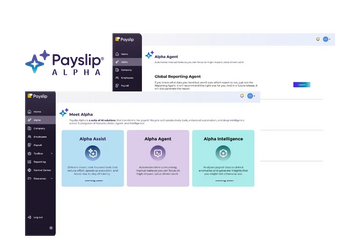
Payslip Alpha: Bringing Purpose-Built AI Into Payroll Operations
Payslip Alpha brings payroll-specific AI capabilities to Payslip's standardized Global-First Data Model.
The suite includes three categories:
Alpha Assist supports repetitive tasks such as pay element mapping and pre-check validations.
Alpha Intelligence helps payroll professionals analyze information, detect anomalies, and investigate potential issues.
Alpha Agent focuses on intelligent automation of time-consuming activities, including reporting, workflow support, and reconciliation-related processes.
Together, these capabilities demonstrate how intelligent technology can support payroll operations while keeping payroll professionals in control.
From Payroll Data to Payroll Intelligence: PayrunIQ
A practical example of AI-powered payroll intelligence available today is PayrunIQ, part of Payslip Alpha.
PayrunIQ allows authorized payroll professionals to ask natural-language questions about their payrun data.
Instead of manually searching through spreadsheets and reports, users can investigate questions such as:
- Which employees received unusually large bonuses?
- How does net pay compare with previous payruns?
- Are there missing cost center details?
- Which payroll changes require further investigation?
This makes payroll information easier to analyze and helps teams identify potential issues more efficiently.
PayrunIQ demonstrates that AI-powered payroll intelligence is not simply a future ambition. It is already helping payroll professionals work with their data in a more intuitive and efficient way.
By combining these capabilities with standardized data, connected systems, and operational controls, Payslip provides a foundation for increasingly intelligent payroll workflows.
Why Human Oversight Remains Essential
As AI becomes more capable, one question remains central:
How much decision-making should organizations delegate to AI in payroll?
Payroll directly affects employees' financial well-being and organizations' legal and regulatory obligations.
An incorrect payment, unauthorized data change, or missed compliance requirement can have serious consequences.
For this reason, AI adoption must be accompanied by clear governance.
Organizations need to define which activities can be automated, which actions require approval, and how AI-generated recommendations are reviewed.
A practical approach involves three levels of responsibility:
AI identifies: Detecting unusual changes, missing information, and potential risks.
AI recommends: Preparing analysis, supporting investigations, and suggesting next steps.
Humans decide: Reviewing findings, approving sensitive actions, and retaining accountability for payroll outcomes.
Payslip Alpha follows a human-centered approach, with customer-data-related AI features disabled by default and subject to organizational activation and oversight.
This reflects an important principle: intelligent payroll technology should strengthen control, not weaken it.
How Can Organizations Start Using Agentic AI in Payroll Today?
Global payroll leaders can begin taking advantage of intelligent automation without waiting for fully autonomous payroll systems.
The starting point is to assess existing payroll operations and identify where AI can deliver practical value.
Five questions can guide that assessment:
1. Is payroll data standardized across countries?
Consistent data makes global reporting and AI analysis more reliable.
2. Are HR, payroll, and finance systems connected?
Reliable integration reduces manual work and provides a more complete operational picture.
3. Can teams monitor the full payroll cycle?
Visibility into tasks, validations, approvals, and exceptions supports proactive management.
4. Are automation rules and approval responsibilities clearly defined?
Intelligent workflows require appropriate governance and accountability.
5. Where can AI deliver immediate operational value?
Practical applications such as anomaly detection, payroll analysis, reporting, and validation support provide opportunities to reduce manual work and improve efficiency.
Organizations that focus on these foundations can begin realizing the benefits of AI while building the operational maturity needed for more advanced agentic workflows.
Global Payroll Is Moving from Reactive Processing to Proactive Control
Global payroll technology is changing what organizations can achieve today.
Traditional payroll systems focused primarily on processing information.
Modern global payroll platforms have introduced greater integration, automation, and visibility.
AI now helps payroll teams analyze information faster, identify potential issues earlier, and reduce repetitive administrative work.
Agentic AI builds on these capabilities by enabling more intelligent coordination of tasks and workflows within defined controls.
The opportunity is not to remove people from payroll decisions.
It is to combine connected data, intelligent automation, operational control, and human expertise to create more efficient and proactive payroll operations.
For global payroll leaders, this means moving beyond constantly reacting to issues and toward managing payroll with greater confidence, visibility, and control.
Intelligent global payroll is no longer just a vision for tomorrow. Organizations can start putting it into action today.
Ready to Take Control of Global Payroll?
Payslip helps organizations standardize payroll data, automate processes, connect existing providers, and gain greater visibility across global operations.
Through Payslip Control, Payslip Connect, and Payslip Alpha, organizations can build more intelligent, efficient, and controlled global payroll operations.
Discover how Payslip is helping global payroll teams move beyond manual processes and put intelligent payroll automation into action today.
Explore the Payslip Global Payroll Control Platform
Frequently Asked Questions About Agentic AI in Global Payroll
Agentic AI in global payroll refers to AI systems that can pursue defined objectives, coordinate tasks, and support actions across payroll workflows within established rules and permissions. Applications include exception investigation, reporting, reconciliation support, and workflow coordination.
Traditional payroll automation follows predefined rules to complete specific tasks. Agentic AI can evaluate information, plan multiple steps, and adapt actions to achieve defined objectives. In payroll, these capabilities operate within appropriate security, governance, and human approval controls.
AI is being used to analyze payroll data, identify anomalies, support validations, investigate discrepancies, and reduce repetitive administrative work. These capabilities help payroll teams improve efficiency and focus on exceptions requiring professional judgment.
Agentic AI can automate or coordinate selected payroll activities where systems, integrations, and permissions support them. However, payroll involves sensitive financial information and complex regulatory obligations, making human accountability and approval essential for critical decisions.
Payslip uses purpose-built AI through Payslip Alpha, which includes Alpha Assist, Alpha Intelligence, and Alpha Agent. These capabilities support payroll analysis, automation, reporting, anomaly detection, and intelligent workflow activities using standardized global payroll data.