

CFOs have increasingly become the drivers of innovation within their organizations.
When leading a transformation of global payroll, the transformation can touch all aspects of the business.
Here are four things CFOs can do to set their projects up for success.
Getting stakeholder buy-in for the transformation
According to the American Express 2023 CFO survey, 71 percent of CFOs report that digital transformation has fallen under their responsibility.
For most such initiatives, there will be multiple objectives and many stakeholders who have goals for their own departments. At the same time, other department leaders will worry that roles and responsibilities on their teams could change to accommodate the new solution.
And for global payroll in particular, there’s often a lack of clarity about what the future operating model will even look like. It’s difficult for people to visualize the complexity of global payroll and its many processes.
Perhaps this is why only about one in seven finance leaders aim “to pursue a bold transformation agenda in the next three years,” Myles Corson et al. at EY write. “This suggests a reluctance to embrace more innovative change agendas that require an appetite for experimentation and new ways of working.”
Overcoming that reluctance can often be done through conversation. CFOs need to meet with payroll leaders, finance leaders, HR leaders and IT leaders to explain the goals and benefits of the transformation project.
Our advice: Communicate proactively and transparently about your goals for a global payroll transformation. Show other executives how the transformation will impact — and ideally benefit — their teams.

Integrating the organization’s data with global payroll systems
The adoption of any new solution opens the door to disruption across the company.
With a new global payroll solution, HR will have immediate concerns about how it will impact the management of benefits and total reward, as well as the policies in place to ensure payroll is compliant with local labor laws in the countries where the organization has a footprint.
Zoom out, though, and you can visualize the ways a new global payroll system can impact data management and data flows across the whole organization. This is because financial executives today need access to data from across the organization, KPMG writes, “including sales (revenue and customer behavior), procurement (spend and vendor behaviors), operations (items and services functional data), human resources (employee and payroll data), and finance (general ledger and annual strategic plans).”
As Zayo Group CFO Jeffrey Noto tells PYMNTS, CFOs today need to have a balanced skill set of financial acumen and tech capabilities because of the role technology plays in their work, and in their decision-making. Therefore, any global payroll solution must integrate with the organization’s tech infrastructure in a way that wasn’t considered important a decade ago.
Our advice: Look for solutions that are designed to integrate with your cornerstone tech platforms, including your HRIS, your CRM or your ERP.
Relying on local payroll providers
Here is an example of how global payroll behaves quite differently from nearly every other core function in an international organization.
Payroll necessarily works on both a local and global level. While you could say the same for the marketing and sales teams, those teams have tools and processes that can zoom in locally or zoom out globally as needed.
Global payroll cannot do this. If you have headquarters in Germany and employees in Colombia, Vietnam, Nigeria, the United States, and Guatemala, you need in-country payroll providers to help ensure you are compliant with Colombia’s labor laws or Nigeria’s tax regime.
Global payroll is a core business process that necessarily relies on the work of in-country experts who are not part of your organization. These folks are vendors and partners over whom you have limited control. And you rely on them both for crucial data and to make sure paychecks go out on time.
This risk has always existed in global payroll. Mitigating that risk is a tech matter.
Our advice: Work locally, but manage globally. Look for a global payroll control platform that lets you assess the performance of in-country providers. This way, if one in-country provider is underperforming, you have the data you need to go find a new provider.

Payroll consists of several systems
Related to the point above, payroll isn’t something international organizations can execute with an off-the-shelf solution. Payroll is too complicated for that.
“Companies mistakenly think there is one global payroll system they can buy,” TMF quotes one of its U.S. payroll experts as saying. “There isn’t.”
Global payroll relies on a combination of local expertise and global control to run smoothly. Most organizations still struggle with this, however, as our July 2023 Global Payroll Survey revealed. According to our data, 70 percent of global payroll managers say it takes four to five days to get a country-level general ledger report.
Making reporting more efficient starts with an understanding of the systems that power payroll, then empowering the payroll team with highly flexible solutions to manage those systems.
Our advice: Look for a global payroll solution that acts as a tech layer on top of core business processes, not as something that demands a rip-and-replace of what is already working. When looking for a solution, prioritize platforms that give you the flexibility to leverage your existing capabilities and enhance the processes that are working for you now.
Learn more
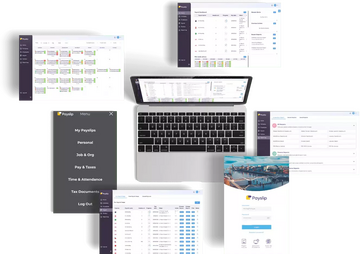
To learn how Payslip’s global payroll control platform can augment and transform your own payroll processes, schedule a tour of our platform today.
Images used under license from Shutterstock.com.